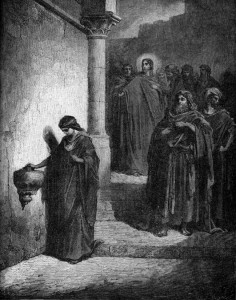
This reflection was inspired by the Sunday Mass readings on Sunday November 8th 2009
1 Kings 17:10-16
Mark 12:41-44
When we read of Jesus’ miracles we usually expect something to change. A leper is made clean, a deformed arm grows, a fever breaks, and the possessed regain sanity and society. We seldom think about miracles where appearances remain constant such as the sun standing still for Joshua and the Israelites (Joshua 10:12-14) or a bush burning but is not consumed by the fire (Exodus 3:1-3). Such miracles Jesus is able to do with only two mites. He can sustain them for a miraculously long time because in heavenly terms a gift of total commitment is richness indeed. Both widows in both readings contribute their whole livelihood as Christ gives up his entire self. Such is the gift of the Eucharist. It’s a gift of Jesus’ total commitment as he is fully there, Body, Blood, Soul and Divinity. And it is a gift we receive with the total commitment of faith.
To those poor souls without the gift of faith the Eucharist appears ordinary, yet if the Church has taught you that Christ is present, veiled beneath the appearance of bread and of wine then you know that it is wondrous and extraordinary. Truly the Eucharist is supernatural though it is not considered a miracle because the senses can not grasp it and because it exists as part of God’s ordinary providence ((The extraordinary element in the miracle — i.e. an event apart from the ordinary course of things; enables us to understand the teaching of theologians that events which ordinarily take place in the natural or supernatural course of Divine Providence are not miracles, although they are beyond the efficiency of natural forces. Thus, e.g., the creation of the soul is not a miracle, for it takes place in the ordinary course of nature. Again, the justification of the sinner, the Eucharistic Presence, the sacramental effects, are not miracles for two reasons: they are beyond the grasp of the senses and they have place in the ordinary course of God’s supernatural Providence.)) ; it is supernatural to we who cannot sense it but natural to God who causes it. Even so, without being a miracle in itself, the Eucharist may be said to sustain miracles. Just as daily the measure of flour did not change for the widow, her son and Elijah, so too the appearances (or accidents) of the Eucharist do not change even though the substance does. This, because of the sustaining presence of Christ, is miraculous. Think about it, when water turns to steam we see the change in its form because its substance remains. With the bread and wine that becomes the Eucharist we see no change in form despite the fact that their substance ceases to exist. So the fact that the appearances remain is a seamless change, a miracle of constancy, so to speak. Saint Thomas Aquinas concurs that it may be said that from the Eucharistic Body proceeds a miraculous sustaining power, which supports the appearances bereft of their natural substances and preserves them from collapse (( Accordingly, the continuance of the appearances without the substance of bread and wine as their connatural substratum is just the reverse of Transubstantiation. If it be further asked, whether these appearances have any subject at all in which they inhere, we must answer with St. Thomas Aquinas [III:77:1], that the idea is to be rejected as unbecoming, as though the Body of Christ, in addition to its own accidents, should also assume those of bread and wine. The most that may be said is, that from the Eucharistic Body proceeds a miraculous sustaining power, which supports the appearances bereft of their natural substances and preserves them from collapse. The position of the Church in this regard may be readily determined from the Council of Constance [1414-1418]. In its eighth session, approved in 1418 by Martin V, this synod condemned the following articles of Wyclif )) .
Another way that the Eucharist is constant is in its potency no matter how small the piece it is broken into. Like the widows two mites which were tiny but potent, the tiniest piece of he Eucharist is 100% potent… it is 100% Body, Blood, Soul and Divinity of Jesus.
The Eucharist is also constant in the respect that it is perpetual sacrifice and is always, somewhere in the world being offered.
It is constant in the respect that the Mass is the same no mater where in the world that you go (despite the sometimes less than subtle liberties often taken). The words of consecration, though they may be translated into vernacular are the same everywhere and throughout history since the Senegal.
Sources:
http://www.newadvent.org/cathen/10338a.htm
http://www.newadvent.org/cathen/05573a.htm#section3