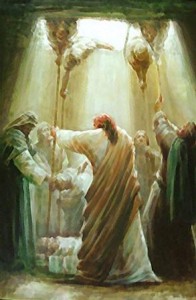
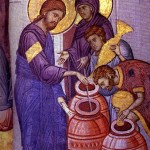
John 2:1-11 When did it happen; at what point did the water turn to wine? There are no active words from Jesus calling the water wine. The waiters followed his instructions, filling the jars to the brim. They would have seen, and smelled the effervescence of wine had the change taken place immediately. Jesus then says “draw some out and take it to the headwaiter.” Some what; some water or some wine? I imagine it was still water and that the waiters were demonstrating faith taking a sample of it to the headwaiter. The actual instant of the miracle seems to be elusive. In the institution of the Eucharist, Jesus’ words are direct, “this is my body,” and again, “this is my blood.” Yet the change is not visible in the Eucharist; Christ’s Body and Blood are present under the appearances of bread and wine. But here at the miracle at the Cana wedding, Jesus is indirect, and the change in substance is visible. If Christ can bring about a visible change of substance without a direct command, as in the miracle of turning water into wine, how much more could He bring about the invisible change of substance when His words are direct, as in the Institution of the Eucharist? The disciples, indeed even priests today, are like the waiters following Jesus’ instructions as the Holy Spirit changes the substance of bread and wine to the Body and Blood of Christ. For the waiters to trust the instructions from Jesus, it took faith: for us to trust the teaching of the Church, it takes faith.
Archive for the ‘Meditations’ Category
When the Water Turned to Wine
Monday, June 13th, 2011Reading Jesus between the Lines
Wednesday, March 16th, 2011“Do whatever He tells you,” these are Mary’s last words recorded in the Bible. Mary doesn’t say anything else; maybe she just looks at Jesus. She knows He’s right that it’s none of their concern if the wine runs out. Still, it matters to Mary. This is important because, in a sense Mary is fulfilling what many Old Testament figures failed to do; she’s interceding for others. Certainly this doesn’t rule out the great bastions of faith like Abraham who interceded for Lot but even a true remnant such as Noah failed to ask pardon for the people God was about to destroy. The problem goes back to Adam who, in full knowledge that his wife Eve had disobeyed God, failed to seek God and ask pardon for her but instead chose to share in disobedience. Shortly after this God punished the couple saying that the man should bring forth the produce of the land by the sweat of his brow and the woman should bring forth her children in pain. Both of these pronouncements are a “bringing forth”; the man with the land and the woman with her children. Both of these pronouncements have something to do with the ministry of Christ which is beginning at Cana.
First, the woman’s pain is not exclusively a physical pain but a deeply spiritual and emotional pain that all mothers experience as their children grow. It is a kind of satisfying yearning for their development into adulthood and perfection. It is this kind of soul wrenching pain, that in its ultimate form, Mary endures while witnessing her son’s passion, and in a more moderate tone, seems to motivate Mary at the wedding at Cana. She is concerned as any good mother would be. She is also, in a way, “bringing forth” her son into public ministry by encouraging Him to inaugurate it with this first public miracle.
Second, the work of the hands of man in bringing forth produce is symbolically present in the wine at the wedding feast at Cana. It is part of our Eucharistic liturgy, stemming from tradition, to thank God both for the wine we have to drink as a gift from Him and for having it as a product of the work of human hands. From there, the priest asks for the intercession of the Holy Spirit to cause bread and wine to become the Body and Blood of Christ for us. God takes the work of man, which the Church ‘brings forth’ as an offering, and completes it by His spirit. God doesn’t reject our work but rather he accepts it and elevates it beyond anything we could possibly have done on our own. The wine, by itself, is insufficient just as the work of man, by itself, is insufficient. Just as the first wine is good wine and the second wine is better wine, so too is the work of man good and the work of God best. It is because of the sacrifice of Christ that these gifts are ‘brought forth’ as wholly perfect gifts to God the Father.
Mary seems to know that Jesus will do something about the shortage of wine. So enveloped in God’s plan is Mary that she may understand the significance of this event deeper than we might ever come to know. Her words precede those of the Father at the transfiguration and yet they have the same meaning. Veiled by clouds at the Transfiguration God said, “This is my Son in whom I am well pleased. Listen to Him,” (Matthew 17:5 Mark 9:6 Luke 9:35 – also compare with the baptism of Jesus [ Mark 1:11 Matthew 3:17 Luke 3:22 ]). Mary is saying much the same thing with her words, “Do whatever He tells you.” But at Cana, instead of a transfiguration we see a transformation, which is something Jesus refused to do when Satan tempted Him in the desert. Stones, Jesus would not turn to bread for His own comfort and nourishment, but water He would turn into wine for the sake of others. Jesus rebuked Satan but heeded Mary because His mother’s plan is in line with His Father’s plan.
The Father’s plan was to reveal Jesus as the Christ so that people might believe in Him and be reconciled and have eternal life. He sent John baptizing to prepare people to receive this good news and John testified that Jesus is “the Lamb of God,” (John 1:29-31 John 3:29-31) . From baptismal waters, waters of cleansing like the ceremonial water in the jars at the wedding at Cana, Jesus brings forth wine, wine of thanksgiving like the wine at the last supper. Turning water into wine manifests the power and glory of Christ, foreshadows a covenant that transforms the old into the new, and fortifies the faith of the disciples. The jars used for ceremonial washing are an integral part of this miracle. Guests would have used the water already to cleanse themselves before eating. Filling them again would seem strange or anticipate another round of cleansing. By using these jars Jesus is saying that the laws of ritual cleanliness are about to come alive through Him. Cleanliness will no longer be just about physical purity, but more so, it will be about spiritual purity. In the proceeding chapter of John, Jesus explains this rebirth in the spirit to Nicodemus (John 3:1-7). So the context of the miracle at the wedding feast is rebirth in the spirit, and whether Mary knew it or not, her intersession fit with all that God wanted to do.
So how does all this transpire in just a few lines of John? It has to do with the two hearts of Mary and Jesus being so connected. Imagine this. Concerned for the bride and groom Mary mentions to Jesus that, “they have no wine.” Perhaps somewhat distracted from another conversation, Jesus replies, “What is this between you and me?” Then they catch each other’s eyes, she finding hope in Him and He reaching deep into her heart. Mary seems to say, ‘it should not matter to anyone but it does to me. I can do nothing but you can do everything.’ Jesus seems to reply, ‘Now here is a heart after my own heart, one who hopes in God; True faith.’ He cannot turn her down, but seeing that it fits with the Father’s plan, Jesus nods his head. That is all that Mary needs and she sets about the work of instilling confidence in the waiters who will, like altar boys, follow along and serve. How close to the heart of God Mary must be! And she wants us to be close to Him too. That’s why she points the way to Christ, asking us to be like the waiters and to do as He says. In following Jesus this way we open ourselves to miracles and transformation.
Jumping for Joy
Monday, November 23rd, 2009
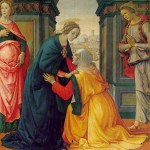
The Visitation by Domenico Ghirlandaio 1486-1490
This reflection is based on Luke 1:39-45 and the Joyful Mysteries: The Visitation.
At the sound of Mary’s greeting the pre-born child John leaped in his mother Elizabeth’s womb. I often wonder about Mary’s greeting, what she said, how far off she was etc.
I imagine the words of Mary’s greeting to be the common Hebrew greeting, “Shalom!” Shalom as you probably know is the Hebrew word for peace but it also means completeness, which implies wellness or wholeness. This greeting coming from our mother who alone received the fullness of grace is a great blessing indeed. Jesus greeted the disciples this way so it is fitting that Mary should greet us this way also. In her many apparitions Mary repeats the phrase, “Peace, peace, peace.” So when I pray the Joyful Mysteries of the Holy Rosary and I get to the Visitation, I now imagine Mary entering the room (her relative’s room and also my own room) and greeting everyone with, “Peace!” and blessing us from the fullness of grace that she received.
Notes:
In paintings Mary is often (but not always) pictured greeting Elizabeth outside the home yet in scripture it is written that she entered before she spoke her greeting. This may be a cultural custom or it may be that the outside grounds are considered part of the home. This also shows me how today Mary enters the homes of those who welcome her in prayer.
Various paintings of the visitation showing the greeting outside:

Visitation by Fra Angelico 1433-34

The Visitation by John of Stagnos, 1637

Visitation of Mary by Rogier van der Weyden 1440-1445

Visitation
O blessed Virgin Mary, conceived without sin, pray for us who have recourse to thee.
A Constant Miracle
Sunday, November 15th, 2009
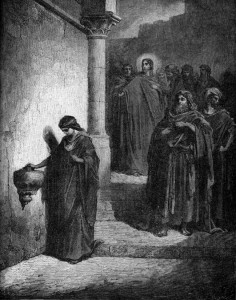
The Widow's Two Mites: Gustave Dore Aprx. 1866-70
This reflection was inspired by the Sunday Mass readings on Sunday November 8th 2009
1 Kings 17:10-16
Mark 12:41-44
When we read of Jesus’ miracles we usually expect something to change. A leper is made clean, a deformed arm grows, a fever breaks, and the possessed regain sanity and society. We seldom think about miracles where appearances remain constant such as the sun standing still for Joshua and the Israelites (Joshua 10:12-14) or a bush burning but is not consumed by the fire (Exodus 3:1-3). Such miracles Jesus is able to do with only two mites. He can sustain them for a miraculously long time because in heavenly terms a gift of total commitment is richness indeed. Both widows in both readings contribute their whole livelihood as Christ gives up his entire self. Such is the gift of the Eucharist. It’s a gift of Jesus’ total commitment as he is fully there, Body, Blood, Soul and Divinity. And it is a gift we receive with the total commitment of faith.
To those poor souls without the gift of faith the Eucharist appears ordinary, yet if the Church has taught you that Christ is present, veiled beneath the appearance of bread and of wine then you know that it is wondrous and extraordinary. Truly the Eucharist is supernatural though it is not considered a miracle because the senses can not grasp it and because it exists as part of God’s ordinary providence[1] ; it is supernatural to we who cannot sense it but natural to God who causes it. Even so, without being a miracle in itself, the Eucharist may be said to sustain miracles. Just as daily the measure of flour did not change for the widow, her son and Elijah, so too the appearances (or accidents) of the Eucharist do not change even though the substance does. This, because of the sustaining presence of Christ, is a miraculous. Think about it, when water turns to steam we see the change in its form because its substance remains. With the bread and wine that becomes the Eucharist we see no change in form despite the fact that their substance ceases to exist. So the fact that the appearances remain is a seamless change, a miracle of constancy, so to speak. Saint Thomas Aquinas concurs that it may be said that from the Eucharistic Body proceeds a miraculous sustaining power, which supports the appearances bereft of their natural substances and preserves them from collapse[2] .
Another way that the Eucharist is constant is in its potency no matter how small the piece it is broken into. Like the widows two mites which were tiny but potent, the tiniest piece of he Eucharist is 100% potent… it is 100% Body, Blood, Soul and Divinity of Jesus.
The Eucharist is also constant in the respect that it is perpetual sacrifice and is always, somewhere in the world being offered.
It is constant in the respect that the Mass is the same no mater where in the world that you go (despite the sometimes less than subtle liberties often taken). The words of consecration, though they may be translated into vernacular are the same everywhere and throughout history since the Senegal.
Sources:
http://www.newadvent.org/cathen/10338a.htm
http://www.newadvent.org/cathen/05573a.htm#section3
- The extraordinary element in the miracle — i.e. an event apart from the ordinary course of things; enables us to understand the teaching of theologians that events which ordinarily take place in the natural or supernatural course of Divine Providence are not miracles, although they are beyond the efficiency of natural forces. Thus, e.g., the creation of the soul is not a miracle, for it takes place in the ordinary course of nature. Again, the justification of the sinner, the Eucharistic Presence, the sacramental effects, are not miracles for two reasons: they are beyond the grasp of the senses and they have place in the ordinary course of God’s supernatural Providence. [↩]
- Accordingly, the continuance of the appearances without the substance of bread and wine as their connatural substratum is just the reverse of Transubstantiation. If it be further asked, whether these appearances have any subject at all in which they inhere, we must answer with St. Thomas Aquinas [III:77:1], that the idea is to be rejected as unbecoming, as though the Body of Christ, in addition to its own accidents, should also assume those of bread and wine. The most that may be said is, that from the Eucharistic Body proceeds a miraculous sustaining power, which supports the appearances bereft of their natural substances and preserves them from collapse. The position of the Church in this regard may be readily determined from the Council of Constance [1414-1418]. In its eighth session, approved in 1418 by Martin V, this synod condemned the following articles of Wyclif [↩]
Transfiguration Cloud
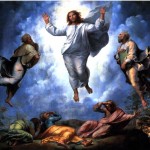
Thursday, October 1st, 2009This is the fruit of an Ignatian exercise on Friday 11-14-2008, contemplating Christ at the Transfiguration (Matthew 17:1-8). I humbly offer this as pure speculation. I have no idea how it stands theologically.

The Transfiguration (top portion), Raffaello Sanzio 1516- 1520
1. Saying yes to Christ’s invitation
2. Praying
3. Staying close to Jesus
This is what we honor Mary for doing at the Annunciation when she heard the good news that she would bare Christ. Mary was likewise rewarded for:
1. Saying yes to be God’s handmaid (Luke 1:38)
2. Praying and keeping these things in her heart (Luke 2:19)
3. Staying close to Jesus
So I think that this idea has merit… that the Apostles bore and raised the Church as Mary bore and raised Jesus. That brings up the question, when was the Church conceived rather than born or instituted (Jesus instituted the Church at His Ascension Matthew 28:18-20)? It may be that the Church was announced at the Transfiguration, conceived at the Last Supper, labored for at the Crucifixion and born at the Resurrection. Indeed, as scripture says, this child was born quickly…
Isaiah 66:7-87Before she was in labour, she brought forth; before her time came to be delivered, she brought forth a man child.8Who hath ever heard such a thing? and who hath seen the like to this? shall the earth bring forth in one day? or shall a nation be brought forth at once, because Sion hath been in labour, and hath brought forth her children?
Resource:
National Catholic Register – Guide to the Rosary, Copyright 2003 Circle Media Inc., pg 25
You were transfigured on the mountain, and your disciples, as much as they were capable of it, beheld your glory, O Christ our God, so that when they should see you crucified they would understand that your Passion was voluntary, and proclaim to the world that you truly are the splendor of the Father.
From Cana to Senegal & from Baptism to Eucharist
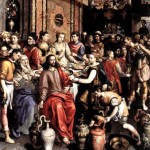
Tuesday, September 1st, 2009RE: John 2:1-11

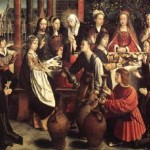
1596-97 Vrouwekathedraal, Antwerp
Wine is representative of the work of human hands because the grapes must be cultivated, harvested, crushed and contained. So when the wine runs out it is representative of the insufficiency of man’s work to provide the elements that facilitate joy and celebration. Since the wedding is a union of man and woman, who are in the likeness of God, it represents the coming together of Heaven and Earth. The question then arises, how will the celebration go on when the wine runs out, or how will the union of man and God be celebrated if man’s work is insufficient? Christ Himself must make up for our insufficiencies. Since no man’s work is sufficient on its own merit to bring him to God, God must make up the difference. How does Jesus bridge the gap? Jesus first instructs the workers to fill jars with water. And here is where every Christian journey begins, with instruction and the purifying waters of baptism. Take notice in John 2:6 that the stone water jars that are used for this miracle are intended to be used for purifying (ceremonial washing: NAB). The baptismal waters are just a beginning because the water must be turned to wine before the head waiter approves. In a sense the head waiter is like God the Father who at His son’s baptism declares, “This is my Son in whom I am well pleased.” Similarly, the head waiter approves of the wine in an extraordinary way. The wine that Christ makes is more than sufficient in both quantity and quality and the head waiter testifies that it is better than the first wine, which was already good. This refers to the first or Old Covenant which is good not because of man’s effort but because of God’s goodness. Now the New Covenant that the Father makes is greater than the first covenant because the sacrifice will not be the blood of creatures but of His own Son. In the context of a wedding celebration this covenant shows God’s plan to save the celebration of life, which is the union of man to God. This plan involves the obedience of man, our receptiveness to His instruction and our effort in carrying out that instruction no matter how insufficient our work is. We see this kind of obedience in the actions of the waiters whom Mary tells to do as Jesus says.

Institution of the Holy Eucharist
In this plan, Jesus leads us from one sacrament to another; from repentance through Baptism to communion through the Holy Eucharist. For now, at the beginning of Jesus’ ministry He makes the water into wine yet when His ministry culminates in the Senegal and on the Cross He will make the wine into His blood. It is through water that we come to His Body and Blood; it is through Baptism that we come to the Holy Eucharist.
© Tim Bartel 2009
You were transfigured on the mountain, and your disciples, as much as they were capable of it, beheld your glory, O Christ our God, so that when they should see you crucified they would understand that your Passion was voluntary, and proclaim to the world that you truly are the splendor of the Father.
Two Standards – Part ONE
Thursday, August 20th, 2009Note:
This post is the result of an Ignatius exercise I did a year ago. The exercise is to contrast the devil’s standard with Christ’s standard. Although I completed the meditation I did not write type the second half (I may have hand written notes but I cannot find them at present). I can still recall some of the images of Christ’s standard and perhaps if I do the exercise again (or if I find my notes) I will publish the second part.
Part ONE:

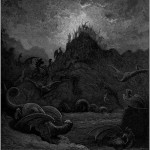
Paradise Lost - Gustave Dore
When I woke up the smoke and fire, dragon and beasts, drumbeat, webs and people were all gone from my sight and I could breathe and feel my heart beating for itself once again. Was it real? I had no doubt even if no one would ever believe me. Gaining my strength I got up and went down the hill into my field to breath in the thick air sweetened with wheat. The grains had grown tall. They were over my head and sun illuminated their dancing heads as the stalks brushed against each other to the movement of gentle breezes. They made a heartwarming bustling sound like women dressed to the hilt in beautiful gowns rushing to make ready for a grand ball. As I moved through the field the waves of stalks parted but for one that stood directly in my path. It was not a stalk of grain but a weed, darker and stronger that the wheat. I thought to cut it down and as I grabbed a hold of the stalk I came close enough to it to see that it had my name written on the main stem. Then when I recoiled, startled at this, I saw another weed and another and still many more all with my name on them.
Note about part two:
In the second part I fall prey to the drum beat but am rescued by a flood of water and am carried on its waves to a brighter land where I meet a king who bids me to sow better seeds.
© Tim Bartel 2008
You were transfigured on the mountain, and your disciples, as much as they were capable of it, beheld your glory, O Christ our God, so that when they should see you crucified they would understand that your Passion was voluntary, and proclaim to the world that you truly are the splendor of the Father.
The Father’s Workshop
Thursday, August 20th, 2009The following is a meditation I enjoyed after a reading from the Gospel on the flight into Egypt. The bible verses were followed by a reading from Catherine Emerich about the difficulties of the journey. We were invited to imagine ourselves in the company of the Holy Family at dinner.

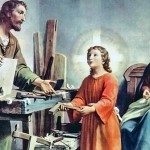
Holy Family in the Workhop
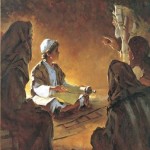
When dinner is ended the boy Jesus addresses me. His hair is wavy and His skin dark and tanned. He is young. I am aware that He is about seven but he acts more like nine or ten. He is mature beyond his age but excited to speak and to show me something. “Come, come with me,” He invites, “I want to show you my father’s workshop.” At once I am aware that the workshop is Joseph’s but also metaphorically the workshop of the Father in heaven. We get there instantly, and the Child Jesus explains, “We build many things here, my father and I.” I am aware that this means also that He and His Devine Father made all things. I notice a stain on a length of wood and Jesus responds, “Yes, it is my blood. I have spilled my blood on the wood many times working here. This isn’t the first and it will not be the last.” I am aware that this is literal and also that it means it is not His last drop of blood but that He will give His last drop also in a work involving wood, the wood of the cross. Young Jesus continues, “We begin work here on Sunday and continue through the week. Thursday is the hardest.” I am aware that this extra load of work on Thursday is a foreshadowing of his passion that begins in agony and that The Child Jesus contemplates while at work. He continues, “On Saturday we go into the house and pray. We pray as we remember the deliverance of the Israelites from Egypt. We pray for our own deliverance from Egypt and we pray for your deliverance from your Egypt.” I am aware that “your Egypt” means both the general salvation of all souls from the hands of the evil one and also deliverance from my personal enslavement to sin.
© Tim Bartel 2008
You were transfigured on the mountain, and your disciples, as much as they were capable of it, beheld your glory, O Christ our God, so that when they should see you crucified they would understand that your Passion was voluntary, and proclaim to the world that you truly are the splendor of the Father.