Archive for the ‘Catholic’ Category

Beauty in Art

Friday, February 5th, 2010

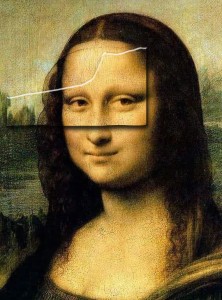
Putting the smile back on the Mona Lisa

La Gioconda AKA Mona Lisa, da Vinci 1503-1506, Cropped to bust, bevel indicates portion shown on The da Vinci Code book cover

La Gioconda AKA Mona Lisa, da Vinci 1503-1506, Cropped to bust, bevel indicates portion shown on The da Vinci Code book cover

The world needs authentic beauty and artists have the responsibility of bringing it to people through their art.” ~ Pope Benedict XVI, Vatican City, Nov. 22, 2009.

In some ways art influences the way we think and in other ways the way we think influences art. In the Renaissance age most art was Christian because the Church was such a great patron to the arts. In the twentieth century art reflected modernism and industrialism. Today art is diverse and eclectic with influences from every corner of the globe largely because of commerce and the Internet. This frenzied exchange of data is accelerating the ebb and tide between cultural expression and pop culture. Which begs the question, are TV, Movies and the Internet an accurate reflection of who we are or are the images helping to shape who we are becoming? It seems that whoever patrons the arts and the media in particular have the steering wheel of the age and of cultural identity.

One recent shift in the tide or turn of the culture wheel seems to be when our attention shifted from the Mona Lisa’s smile to her eyes. The beauty of the Mona Lisa was chiefly in her smile as many a poet has mused. Her smile leads us to wonder what she was thinking. In contrast, has anyone ever written a poem about Mona Lisa’s eyes? Nevertheless today’s graphic art has little to no concern for her smile. Instead, today’s popular art is concerned with the eyes and with appearances. In other words it’s all about superficiality. There was one image in particular that epitomized this shift. Remember the image that popularized that insipid book The da Vinci Code? It was the image of the Mona Lisa with her mouth torn away. She was robbed of the central thing that made that work famous. She was unable to speak and this is precisely what the book attempted to do in words. It presented only the details that Dan Brown wanted us to see and which he pronounced as the whole truth. The image was a dead giveaway that the masterpieces which he hijacked for his plot wouldn’t get a chance to tell the whole story. I am surprised that feminists didn’t object to the image of the Mona Lisa as a woman whose mouth had been torn, hidden or stolen away; a woman whose voice had been squelched. But then again that woman is really not the feminine mystique that feminists protect but rather the Catholic Church (reasoned by the books content not the image of the Mona Lisa).

Contrast this with the Renaissance age of art when the beauty in the master painter’s works spoke the gospel truth loud and clear. Pope Benedict XVI, addressed the artists of the world last November (Nov 22 2009 Vatican City) saying, “Christianity from its earliest days has recognized the value of the arts and has made wise use of their varied language to express her unvarying message of salvation.” It wasn’t that long ago that beauty in art still invited the observer to lift his mind and heart toward heaven. Pope Benedict continues, “What is capable of restoring enthusiasm and confidence, what can encourage the human spirit to rediscover its path, to raise its eyes to the horizon, to dream of a life worthy of its vocation – if not beauty?” And what more beautiful things are there than heaven and salvation? Indeed, Pope Benedict concludes, “Art, in all its forms, at the point where it encounters the great questions of our existence, … can take on a religious quality, thereby turning into a path of profound inner reflection and spirituality.” It’s no wonder that the Church is still the custodian of some of the world’s greatest and most renowned masterpieces including the Sistine chapel ceiling, Saint Peter’s Basilica, Notre Dame, the Thinker, The Last Supper, and the list goes on and on and on.

In architecture there are some Gothic basilicas with ornate flying buttresses that render the totality of the whole construction so visually poetic they soar beyond architecture and pierce the heart on their way toward heaven. This is what truly great art should do. It should make you gasp in awe of grandeur not in shock of obscenity. It shouldn’t just peak the interest with hidden puzzles and pseudo-religious-neo-pagan-socio-psycho-political-mind-babble. Some of that stuff can seem fun or engaging but mostly it pales in relation to the beauty in the works of the masters. The reason the masters works endure is because the subject satisfied deep desires of the soul rather than shallow desires of the flesh or the world. Here let me quote Pope Benedict XVI one more time, “Beauty, whether that of the natural universe or that expressed in art, precisely because it opens up and broadens the horizons of human awareness, pointing us beyond ourselves, bringing us face to face with the abyss of Infinity, can become a path towards the transcendent, towards the ultimate Mystery, towards God.”

Achieving the transcendent in art requires freedom not just in liberties and rights recognized by the law of a good nation but by the good choices of people unfettered by the chains of materialism and unconditioned by the cardinal rule of modernism, which may be summed up as ‘think free as long as you don’t think as the Church thinks’. Anyone can see that such a rule has not the ultimate and complete freedom that it pretends. In contrast the Church says ‘wherever the truth is, recognize it, acknowledge it, and believe it.’ I can find little or no truth in tearing off the smile of the Mona Lisa (tearing it off just smacks of truth killers and silencers like socialism and communism). But I can find truth in protecting her smile and wondering of what beautiful thing she was thinking. It’s not a question of relativity like beauty belonging to the eye of the beholder but considering that the internet is a great gallery of parading images the beholder may get the last word. It may be that the new patron of the arts is the people and that their payment is their praise. Therefore pray that soon many artists will, by their free choice, concede that their responsibility is greater than themselves and more valuable than the praise of their peers. Pray that these will realize that the pinnacle and purpose of art is not to honor creation or creativity rather it is to honor the creator.
Read the whole story of the popes meeting with artists as reported by the Vatican Information Service.

Sources:
VIS – Nov 23 2009
The Catholic Association

Liturgical References in Helinandus Gradale Text

Saturday, January 30th, 2010

My Translation of Helinandus’ “Gradale” Text:
gradualDuring this time (117 – 719)[1] a hermit in Britain was shown a miraculous vision by an angel, a vision of the noble [Saint[2]] Joseph (of Arimathea) member of the Sanhedrin[3], who took down the body of the Lord from the Cross[4] and of that bowl/plate in which the Lord had dinner with the disciples his friends, after this occurrence (the vision) the hermit described an existing[5] account by the name of “gradale.” “Gradalis” also indeed “gradale” in French[6] means wide and somewhat deep dish in which precious sacrificial feasts (or banquets) the wealthy are accustom to serve step-by-step, one set of morsels after another in diverse succession (or arranged in rows). It is said (used) also among the common people who call it “greal” because those who consume it are thankful[7] and welcome it, and (rightly) so on account of its content, that same (vessel) perhaps is ornamented with silver or even another precious material, and so on account of its contents the very same class use it on many occasions of sacrificial feasts (banquets) of great value. So far I have not been able to find this account in Latin however only a certain few of nobility have it in French[8] writing, and neither was it entirely easy to find.

Liturgical meaning is explicit:
First let me clearly state that I have no formal training in the transcription or translation of Latin into English. I have done my best with a few Latin dictionaries to make this translation admittedly with a Catholic world view (that was also prevalent in Helinandus’ day and which he undoubtedly held as a Roman Catholic monk). I believe that the essence of what Helenandus was trying to convey is decently reflected here but at the same time I welcome any professional advice given in charity from better qualified individuals.

I noticed that where certain words had several choices of meanings that some might make explicit references to the liturgy of the Mass. Also some phrases are clearer when understood from a Catholic perspective of the Holy Eucharist. For instance the Latin word “dapes” may be translated as “sacrificial feast/meal” or more plainly as “banquet”. Some dictionaries offer even “meal of meat”. In other words we are talking about real flesh or meat.
Then there is also the coupling of the term “preciosae” with “dapes” which is clearly defined as “precious”. Is it a coincidence that Catholics refer to one species of the Eucharist as the Precious Blood?

The meal is served “gradatim” from which we can see that the word “gradale” or “gradalis” is derived (Gradale as etymologists inform us is where we get the term grail as in Holy Grail). “Gradatim” literally means step-by-step or gradual. The Holy Mass is said and prayed in step-by-step fashion and the oldest of the four important chants of the Mass is called the Gradual. The name Gradual came from the medieval practice of singing a psalm while standing on the set of steps leading to the Ambo. Not all the way up the steps but on the way up… gradually ascending them.

Consider also that when the common people partake of this meal they are thankful. The Latin word “grata” means thanks as does the Greek word “Eucharist” which we name our Blessed Sacrament. This is the proper way to approach the Most Holy Eucharist, with a humble and contrite heart, with thanksgiving.

But most compelling is not a single word or a pairing of words but a repeated phrase, “and so by means of its content.” From this phrase we see that it is not the grail itself that gives the rich and the poor alike the reason to be thankful. It is not for the glorification of the grail itself that it should be decorated lavishly. Rather it is that precious sacrifice which the grail contains which merits veneration (cf Matthew 23:20-22). Of course the mere fact that Christ used it makes it a relic par excellence!

From these translations and considering that Helinandus was a Cistercian monk who would certainly have understood the liturgical references in his choice of words, I believe it is a reasonable conclusion that the term “gradale” from its very beginning was blessed with a deep liturgical meaning.

Original Latin:
Hoc tempore (717-719) in Britannia cuidam heremitae demonstrata fuit [monstrata est] mirabilis quaedam visio per angelum de [santo] Ioseph decurione nobili, qui corpus Domini deposuit de cruce et de catino illo vel [sive] paropside, in quo Domius caenavit cum discipulis suis, de quo ab eodem heremita descripta est historia quae dicitur gradale [de gradali]. Gradalis autem vel [sive] gradale gallice dicitur scutella lata et aliquantulum profunda, in qua preciosae dapes [add: cum suo jure] divitibus solent apponi gradatim, unus morsellus post alium in diversis ordinibus. Dicitur et vulgari nomine greal [graalz], quia grata et acceptabilis est in ea comedenti, tum propter continens, quia forte argentea est vel de alia precioso materia, tum propter contentum .i. [id est] ordinem multiplicem dapium preciosarum. Hanc historiam latine scriptam invenire non potui sed tantum gallice scripta habetur a quibusdem proceribus, nec facil, ut aiunt, tota inveniri potest.

Resources:
Introduction, The Grail Legend by Emma Jung, Marie Louise von Franz, pg 29
Concerning the Word Graal Greal, Modern Philology, March 1916 pg 185
Latin – English translations:
- Pocket Oxford LATIN Dictionary, Oxford University Press Inc., New York
- Catholic Archives
- Starz21 Online Translator
- Translation Guide Online Translator
New Advent
Ancient Texts

Luke 23:50-53
View in: NAB Vulg Greek
50And behold there was a man named Joseph, who was a counsellor, a good and just man,
51(The same had not consented to their counsel and doings;) of Arimathea, a city of Judea; who also himself looked for the kingdom of God.
52This man went to Pilate, and begged the body of Jesus.
53And taking him down, he wrapped him in fine linen, and laid him in a sepulchre that was hewed in stone, wherein never yet any man had been laid.
Matthew 27:57-60
View in: NAB Vulg Greek
57And when it was evening, there came a certain rich man of Arimathea, named Joseph, who also himself was a disciple of Jesus.
58He went to Pilate, and asked the body of Jesus. Then Pilate commanded that the body should be delivered.
59And Joseph taking the body, wrapped it up in a clean linen cloth.
60And laid it in his own new monument, which he had hewed out in a rock. And he rolled a great stone to the door of the monument, and went his way.
John 19:38
View in: NAB Vulg Greek
38And after these things, Joseph of Arimathea (because he was a disciple of Jesus, but secretly for fear of the Jews) besought Pilate that he might take away the body of Jesus. And Pilate gave leave. He came therefore, and took the body of Jesus.
Matthew 23:20-22
View in: NAB Vulg Greek
20He therefore that sweareth by the altar, sweareth by it, and by all things that are upon it:
21And whosoever shall swear by temple, sweareth by it, and by him that dwelleth in it:
22And he that sweareth by heaven, sweareth by the throne of God, and by him that sitteth thereon.
  1. implied by context of the preceding entry I presume []
  2. some texts have the word Sancto which means saint []
  3. decurione – means senator. []
  4. From scripture we know that Joseph of Arimathea was a member of the Sanhedrin and it is this status which gained him access to request the body of Jesus and gave him the means for His burial. Luke 23:50-53 Matthew 27:57-60 John 19:38 []
  5. it may or may not have been extant at the time Helinandus wrote this []
  6. Gall – from Gallic meaning of or pertaining to France []
  7. some translate grata as agreeable because of the phonetic similarity but this doesn’t exist in the Latin pronunciation []
  8. Gallice – from Gallic meaning of or pertaining to France []

Faith a Chair and a Leap

Wednesday, January 6th, 2010

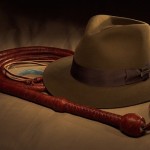
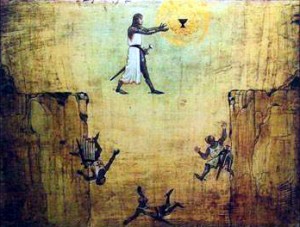
Leap of Faith from Indiana Jones and the Last Crusade

Leap of Faith from Indiana Jones and the Last Crusade

Modernists say that faith is a foolish blind leap but theologians say that faith is a contemplated and certain leap. We both agree that faith is a leap but we disagree that faith is blind and foolish. Consider a man sitting in a chair. He is certain that the chair is in fact under him because it is presently supporting his weight. [1] At some point the man will stand temporarily and then sit back down again. When the man stands, he no longer sees or feels the chair. Nor do any of his senses assure him that the chair remains where it aught to be; that it is where it was. The man has only the recollection that the chair is there and upon that secure knowledge he sits again. Is the man uncertain of the presence of the chair? Is the man foolish for trusting that the chair is there? So too is man certain that he did not create himself and therefore there must be another in who rests the sufficient cause for his own being. That knowledge is akin to first sitting in the chair. Trusting in the revealed truth of sacred Scripture and Tradition is akin to the second sitting in the chair. They are both predicated on the certainty that God and truth exist just as the chair exists. Modernists play the prank of yanking the chair out from under us in the lamest way. They are incapable of removing the chair of faith so they shout, “look out the chair is gone,” when all the while the chair has not moved. It is a mean trick of misdirection and it catches only some of the people some of the time.

While on vacation at Copper Canyon my daughter, noticing the cliff jumpers, asked if I would ever do something like that. Indeed in my younger days I had done that and worse. Wanting to show her a side of myself that I have never shown her before, I crossed over to the cliff and promptly ascended the path to the highest point from where none in our company had yet flung themselves. At the top there were a few people trying to muster the courage to jump and I asked them, “It is deep enough right? I mean people have done this and survived right?” Indeed I had seen a few people not in our party jump from this height earlier. I looked down at the water and saw that there were patches of discolorations and from this was able to discern the deep areas. After that I leaned forward and with a great push of my legs leaped of the ledge. The plummet was fast, the landing furious and the fanfare glorious. Never have I considered that leap foolish, since I ascertained the degree of safety before hand. Certainly there was some risk but all the while I was assured by the actions of the people that had gone before me. The leap of faith is just like this leap at Copper Canyon; it is certified by the Tradition of those saints who precede us.

At this I expect that modernists will point to the classic example of the Brooklyn Bridge jumpers saying, “If everybody jumped of the Brooklyn Bridge that still wouldn’t make it right.” First, the leap of faith is nothing like the Brooklyn Bridge. Those who jump off the Brooklyn Bridge or travel down the Niagara Falls in a barrel are in no way assured of their safety. They are the extreme, the fringe of society who in no way characterize the lives of the saints. Second, not everyone… not even a majority of this culture is exactly standing in line to take the leap of faith. Really, when was the last time you looked at the red and white martyrs of the faith and said, “Ooo! There’s something everyone is lining up to do, I can’t wait for my turn!?”

Luke 23:50-53
View in: NAB Vulg Greek
50And behold there was a man named Joseph, who was a counsellor, a good and just man,
51(The same had not consented to their counsel and doings;) of Arimathea, a city of Judea; who also himself looked for the kingdom of God.
52This man went to Pilate, and begged the body of Jesus.
53And taking him down, he wrapped him in fine linen, and laid him in a sepulchre that was hewed in stone, wherein never yet any man had been laid.
Matthew 27:57-60
View in: NAB Vulg Greek
57And when it was evening, there came a certain rich man of Arimathea, named Joseph, who also himself was a disciple of Jesus.
58He went to Pilate, and asked the body of Jesus. Then Pilate commanded that the body should be delivered.
59And Joseph taking the body, wrapped it up in a clean linen cloth.
60And laid it in his own new monument, which he had hewed out in a rock. And he rolled a great stone to the door of the monument, and went his way.
John 19:38
View in: NAB Vulg Greek
38And after these things, Joseph of Arimathea (because he was a disciple of Jesus, but secretly for fear of the Jews) besought Pilate that he might take away the body of Jesus. And Pilate gave leave. He came therefore, and took the body of Jesus.
Matthew 23:20-22
View in: NAB Vulg Greek
20He therefore that sweareth by the altar, sweareth by it, and by all things that are upon it:
21And whosoever shall swear by temple, sweareth by it, and by him that dwelleth in it:
22And he that sweareth by heaven, sweareth by the throne of God, and by him that sitteth thereon.
  1. Let us for the time being suspend the modernist argument that we cannot trust our senses and for the sake of this argument accept that the man is in fact supported by the chair. The reality of the common empirical experience of sitting in chairs should suffice for any rational person. []

The Ultimate Cup of Kindness

Thursday, December 31st, 2009

In the famous song Auld Lang Syne, which is about the good old days, the first line asks the question, “Should old acquaintance be forgot and never brought to mind?” But the question is really would that be proper to forget those we’ve met long ago? And the song answers that question by rousing us to drink a pint of kindness in their honor. So does that mean that Old Lang Sine is just an old Scottish drinking song? Well, it may have started that way but the sentiment has caught on and grown into something more. Remembering the past over brew or bubbly has become a time for pastimes; a way of putting the best to rest in order to welcome the new into the clear blue of now. New Year’s Eve is that odd moment when what has been meets what will be, when the experiences of the past teach us what resolutions we should make today for the sake of tomorrow. This twilight time of now which lies between yesterday and tomorrow may be somewhat akin to eternity because it is an ever-present now. It’s that eternal now-ness if you will, which the Lord draws us into with His celebration and sacrifice. When at the Last Supper Jesus took the cup and asked us to share it in remembrance of Him it was more than just a request to recall the good old days, it was a command to continue in His presence. In a way, to drink of the cup of His blood is to drink from the cup of the ultimate kindness, since He who is goodness itself gave His life in order to fill it.
Luke 23:50-53
View in: NAB Vulg Greek
50And behold there was a man named Joseph, who was a counsellor, a good and just man,
51(The same had not consented to their counsel and doings;) of Arimathea, a city of Judea; who also himself looked for the kingdom of God.
52This man went to Pilate, and begged the body of Jesus.
53And taking him down, he wrapped him in fine linen, and laid him in a sepulchre that was hewed in stone, wherein never yet any man had been laid.
Matthew 27:57-60
View in: NAB Vulg Greek
57And when it was evening, there came a certain rich man of Arimathea, named Joseph, who also himself was a disciple of Jesus.
58He went to Pilate, and asked the body of Jesus. Then Pilate commanded that the body should be delivered.
59And Joseph taking the body, wrapped it up in a clean linen cloth.
60And laid it in his own new monument, which he had hewed out in a rock. And he rolled a great stone to the door of the monument, and went his way.
John 19:38
View in: NAB Vulg Greek
38And after these things, Joseph of Arimathea (because he was a disciple of Jesus, but secretly for fear of the Jews) besought Pilate that he might take away the body of Jesus. And Pilate gave leave. He came therefore, and took the body of Jesus.
Matthew 23:20-22
View in: NAB Vulg Greek
20He therefore that sweareth by the altar, sweareth by it, and by all things that are upon it:
21And whosoever shall swear by temple, sweareth by it, and by him that dwelleth in it:
22And he that sweareth by heaven, sweareth by the throne of God, and by him that sitteth thereon.

Selflessness and Chirstmas

Thursday, December 24th, 2009

+JMJ+

For this post during the week of Christmas I would like to share with you a short quotation from the late Bishop Fulton Sheen whose cause is being considered for canonized sainthood.

“What a lesson nature teaches about selflessness! Clouds, playing like lambs in the pastures of the sky, never keep their treasures of moisture to themselves, but pour them out in the beautiful benediction of rain to a thirsty earth. No drop of water leads a selfish life. There is no breeze without its mission. Human lives were not sent into this world as ornaments. God has prettier things for that purpose. As the bird that sings for others gladdens its own heart with song, as rivers flee the decay of stagnant self-content to service the mighty ocean, as the sun burns itself out to light a world, so does everything – man included – become good by doing good to others.

But if we are to do good to others, they must be loved for God’s sake. No moral profit comes from doing good to another because “she can get it for us wholesale” or from giving gifts to others because of the pleasure they give us. There is not even great merit in doing good to those who love us. “If you love those who love you, what reward is there in that? Do not sinners do the same?” (Luke 6:32). The greatest spiritual profit comes from loving those who hate us, and from giving gifts and dinners to those who cannot give anything in return, for then recompense will be made in the Kingdom of heaven (cf Luke 14:12-14).”[1]

This is just what God the Father has done for us by sending to us His only begotten Son, we who have nothing except that which is already His, we who are not always His friend but have been His betrayer by our sins. Yet He gives us Jesus anyway for He loves us to such a perfect extent. What then should be our response to this perfect love? Shouldn’t it be the same as Mary’s at the annunciation? Shouldn’t we say yes to God with our whole selves[2] ? This is one of the reasons why I think the national holiday of Thanksgiving is appropriately placed the month before Christmas and it initiates Advent with a right spirit of thankfulness. Thank you God for your wondrous, perfect and Holy goodness. Thank you God for redeeming us in Christ. Thank you God. Alleluia!

RESOURCES:
A great Christmas Message from Bishop Fulton Sheen prepared by Catholic speakers Mathew Arnold and Terry Barber: Saint Joe Podcast – God Love You – Christ Was Pre-Announced

Luke 23:50-53
View in: NAB Vulg Greek
50And behold there was a man named Joseph, who was a counsellor, a good and just man,
51(The same had not consented to their counsel and doings;) of Arimathea, a city of Judea; who also himself looked for the kingdom of God.
52This man went to Pilate, and begged the body of Jesus.
53And taking him down, he wrapped him in fine linen, and laid him in a sepulchre that was hewed in stone, wherein never yet any man had been laid.
Matthew 27:57-60
View in: NAB Vulg Greek
57And when it was evening, there came a certain rich man of Arimathea, named Joseph, who also himself was a disciple of Jesus.
58He went to Pilate, and asked the body of Jesus. Then Pilate commanded that the body should be delivered.
59And Joseph taking the body, wrapped it up in a clean linen cloth.
60And laid it in his own new monument, which he had hewed out in a rock. And he rolled a great stone to the door of the monument, and went his way.
John 19:38
View in: NAB Vulg Greek
38And after these things, Joseph of Arimathea (because he was a disciple of Jesus, but secretly for fear of the Jews) besought Pilate that he might take away the body of Jesus. And Pilate gave leave. He came therefore, and took the body of Jesus.
Matthew 23:20-22
View in: NAB Vulg Greek
20He therefore that sweareth by the altar, sweareth by it, and by all things that are upon it:
21And whosoever shall swear by temple, sweareth by it, and by him that dwelleth in it:
22And he that sweareth by heaven, sweareth by the throne of God, and by him that sitteth thereon.
Luke 6:32
View in: NAB Vulg Greek
32And if you love them that love you, what thanks are to you? for sinners also love those that love them.
Luke 14:12-14
View in: NAB Vulg Greek
12And he said to him also that had invited him: When thou makest a dinner or a supper, call not thy friends, nor thy brethren, nor thy kinsmen, nor thy neighbours who are rich; lest perhaps they also invite thee again, and a recompense be made to thee.
13But when thou makest a feast, call the poor, the maimed, the lame, and the blind;
14And thou shalt be blessed, because they have not wherewith to make thee recompense: for recompense shall be made thee at the resurrection of the just.
CCC 142-143
¶142 By his Revelation, "the invisible God, from the fullness of his love, addresses men as his friends, and moves among them, in order to invite and receive them into his own company." The adequate response to this invitation is faith.
¶143 By faith, man completely submits his intellect and his will to God. With his whole being man gives his assent to God the revealer. Sacred Scripture calls this human response to God, the author of revelation, "the obedience of faith".
  1. Way to Inner Peace, Fulton J. Sheen, Alba House NY – Society of Saint Paul Inc., 1995 []
  2. The Compendium to the Catechism says that our response to God should be an “obedience of faith, which means the full surrender of ourselves to God and the acceptance of his truth, insofar as it is guaranteed by the One who is Truth itself.” CCC 142-143 []

The Long Run

Sunday, December 6th, 2009

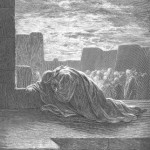
Ezra Kneels in Prayer - By Gustave DoreFootball fans love to celebrate spectacular touch downs won by deep passes and long runs but we seldom cheer the gain of a few yards even though it’s the few yard gains hard fought for that have won many a game. The military understands this as well, that some battles are won by persistence. And our spiritual enemies too know that they have conquered souls and brought them to ruin by wearing down the faithful. That’s why it’s extremely important to stay vigilant and never to loose heart for the fight.

An every day life example of vigilance might be the ant problem that we battle annually near the tail end of summer and into the early fall. While I know that Raid and other toxic chemical concoctions have the long lasting effect of eradicating the vermin we choose not to use such toxins. So in season we fight the battle of the ants almost daily, with safer more green alternatives. The ants stop for a while and then they come back. This goes on for a few weeks until the ants finally give up. It’s a frustrating experience but if we gave in and used the toxic stuff who knows what affect that would have on us in the long run. And that’s what these battles are about; the long run not just the immediate gain of a few yards but the cumulative gain of a first down, the taking of a hill, the conquering of vice. Once the ants are gone I have a sigh of relief but I start looking for other areas where they might shift their activity. It’s the same way with demons who will try to gain a toehold anywhere they can. That’s why I think it’s important to reinforce the message that you should never give out… never give in… and never give up. And if we loose ground its important to remember that the goal is a first down, then a touchdown and then the final score. Don’t give up your prayer life, not when your tired while the going is tough and not when when your bored while the going is easy. Vigilance is twenty-for-seven.

The fictional character Rocky is exemplary in this respect. In the original movie Rocky and in the newest movie Rocky Balboa, his goal was less to win than it was to “go the distance”. Finishing the race was wining and that kind of winning only comes by getting up when you’re knocked down. Sylvester Stallone wrote it this way in the new movie, “But it ain’t about how hard ya hit. It’s about how hard you can get it and keep moving forward. How much you can take and keep moving forward. That’s how winning is done!” Saint Paul said something like it too. He said to run the good race (NAB).

2 Timothy 4:7
7I have fought a good fight, I have finished my course, I have kept the faith.

And

1 Corinthians 9:24
24Know you not that they that run in the race, all run indeed, but one receiveth the prize? So run that you may obtain.

Prayer is a battle of constant vigilance. So pray, even when you think you can’t… even after you have been knocked down… just open your heart, then open your mouth and speak to God. He knows you are knocked down and He’ll lift you up.

A good prayer for deliverance is the Our father since it ends with “deliver us from evil,” but here I would like to share with you O Saving Victim (O Sal­u­tar­is Hos­tia – written by Saint Thomas Aquinas), which is generally sung at the Exposition or Benediction of the Blessed Sacrament.

O saving Victim, open wide
The gate of Heaven to man below;
Our foes press on from every side;
Your aid supply; Your strength bestow.

To your great Name be endless praise;
Immortal Godhead, One in Three;
Grant us, for endless length of days,
In our true native land to be.

Luke 23:50-53
View in: NAB Vulg Greek
50And behold there was a man named Joseph, who was a counsellor, a good and just man,
51(The same had not consented to their counsel and doings;) of Arimathea, a city of Judea; who also himself looked for the kingdom of God.
52This man went to Pilate, and begged the body of Jesus.
53And taking him down, he wrapped him in fine linen, and laid him in a sepulchre that was hewed in stone, wherein never yet any man had been laid.
Matthew 27:57-60
View in: NAB Vulg Greek
57And when it was evening, there came a certain rich man of Arimathea, named Joseph, who also himself was a disciple of Jesus.
58He went to Pilate, and asked the body of Jesus. Then Pilate commanded that the body should be delivered.
59And Joseph taking the body, wrapped it up in a clean linen cloth.
60And laid it in his own new monument, which he had hewed out in a rock. And he rolled a great stone to the door of the monument, and went his way.
John 19:38
View in: NAB Vulg Greek
38And after these things, Joseph of Arimathea (because he was a disciple of Jesus, but secretly for fear of the Jews) besought Pilate that he might take away the body of Jesus. And Pilate gave leave. He came therefore, and took the body of Jesus.
Matthew 23:20-22
View in: NAB Vulg Greek
20He therefore that sweareth by the altar, sweareth by it, and by all things that are upon it:
21And whosoever shall swear by temple, sweareth by it, and by him that dwelleth in it:
22And he that sweareth by heaven, sweareth by the throne of God, and by him that sitteth thereon.
Luke 6:32
View in: NAB Vulg Greek
32And if you love them that love you, what thanks are to you? for sinners also love those that love them.
Luke 14:12-14
View in: NAB Vulg Greek
12And he said to him also that had invited him: When thou makest a dinner or a supper, call not thy friends, nor thy brethren, nor thy kinsmen, nor thy neighbours who are rich; lest perhaps they also invite thee again, and a recompense be made to thee.
13But when thou makest a feast, call the poor, the maimed, the lame, and the blind;
14And thou shalt be blessed, because they have not wherewith to make thee recompense: for recompense shall be made thee at the resurrection of the just.
CCC 142-143
¶142 By his Revelation, "the invisible God, from the fullness of his love, addresses men as his friends, and moves among them, in order to invite and receive them into his own company." The adequate response to this invitation is faith.
¶143 By faith, man completely submits his intellect and his will to God. With his whole being man gives his assent to God the revealer. Sacred Scripture calls this human response to God, the author of revelation, "the obedience of faith".

Jumping for Joy

Monday, November 23rd, 2009
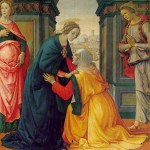
The Visitation by Domenico Ghirlandaio 1486-1490

The Visitation by Domenico Ghirlandaio 1486-1490

This reflection is based on Luke 1:39-45 and the Joyful Mysteries: The Visitation.

At the sound of Mary’s greeting the pre-born child John leaped in his mother Elizabeth’s womb. I often wonder about Mary’s greeting, what she said, how far off she was etc.

I imagine the words of Mary’s greeting to be the common Hebrew greeting, “Shalom!” Shalom as you probably know is the Hebrew word for peace but it also means completeness, which implies wellness or wholeness. This greeting coming from our mother who alone received the fullness of grace is a great blessing indeed. Jesus greeted the disciples this way so it is fitting that Mary should greet us this way also. In her many apparitions Mary repeats the phrase, “Peace, peace, peace.” So when I pray the Joyful Mysteries of the Holy Rosary and I get to the Visitation, I now imagine Mary entering the room (her relative’s room and also my own room) and greeting everyone with, “Peace!” and blessing us from the fullness of grace that she received.

Notes:
In paintings Mary is often (but not always) pictured greeting Elizabeth outside the home yet in scripture it is written that she entered before she spoke her greeting. This may be a cultural custom or it may be that the outside grounds are considered part of the home. This also shows me how today Mary enters the homes of those who welcome her in prayer.

Various paintings of the visitation showing the greeting outside:

Visitation by Fra Angelico 1433-34

Visitation by Fra Angelico 1433-34


The Visitation by John of Stagnos, 1637

The Visitation by John of Stagnos, 1637


Visitation of Mary by Rogier van der Weyden 1440-1445

Visitation of Mary by Rogier van der Weyden 1440-1445


Visitation

Visitation

O blessed Virgin Mary, conceived without sin, pray for us who have recourse to thee.

Luke 23:50-53
View in: NAB Vulg Greek
50And behold there was a man named Joseph, who was a counsellor, a good and just man,
51(The same had not consented to their counsel and doings;) of Arimathea, a city of Judea; who also himself looked for the kingdom of God.
52This man went to Pilate, and begged the body of Jesus.
53And taking him down, he wrapped him in fine linen, and laid him in a sepulchre that was hewed in stone, wherein never yet any man had been laid.
Matthew 27:57-60
View in: NAB Vulg Greek
57And when it was evening, there came a certain rich man of Arimathea, named Joseph, who also himself was a disciple of Jesus.
58He went to Pilate, and asked the body of Jesus. Then Pilate commanded that the body should be delivered.
59And Joseph taking the body, wrapped it up in a clean linen cloth.
60And laid it in his own new monument, which he had hewed out in a rock. And he rolled a great stone to the door of the monument, and went his way.
John 19:38
View in: NAB Vulg Greek
38And after these things, Joseph of Arimathea (because he was a disciple of Jesus, but secretly for fear of the Jews) besought Pilate that he might take away the body of Jesus. And Pilate gave leave. He came therefore, and took the body of Jesus.
Matthew 23:20-22
View in: NAB Vulg Greek
20He therefore that sweareth by the altar, sweareth by it, and by all things that are upon it:
21And whosoever shall swear by temple, sweareth by it, and by him that dwelleth in it:
22And he that sweareth by heaven, sweareth by the throne of God, and by him that sitteth thereon.
Luke 6:32
View in: NAB Vulg Greek
32And if you love them that love you, what thanks are to you? for sinners also love those that love them.
Luke 14:12-14
View in: NAB Vulg Greek
12And he said to him also that had invited him: When thou makest a dinner or a supper, call not thy friends, nor thy brethren, nor thy kinsmen, nor thy neighbours who are rich; lest perhaps they also invite thee again, and a recompense be made to thee.
13But when thou makest a feast, call the poor, the maimed, the lame, and the blind;
14And thou shalt be blessed, because they have not wherewith to make thee recompense: for recompense shall be made thee at the resurrection of the just.
CCC 142-143
¶142 By his Revelation, "the invisible God, from the fullness of his love, addresses men as his friends, and moves among them, in order to invite and receive them into his own company." The adequate response to this invitation is faith.
¶143 By faith, man completely submits his intellect and his will to God. With his whole being man gives his assent to God the revealer. Sacred Scripture calls this human response to God, the author of revelation, "the obedience of faith".
Luke 1:39-45
View in: NAB Vulg Greek
39And Mary rising up in those days, went into the hill country with haste into a city of Juda.
40And she entered into the house of Zachary, and saluted Elizabeth.
41And it came to pass, that when Elizabeth heard the salutation of Mary, the infant leaped in her womb. And Elizabeth was filled with the Holy Ghost:
42And she cried out with a loud voice, and said: Blessed art thou among women, and blessed is the fruit of thy womb.
43And whence is this to me, that the mother of my Lord should come to me?
44For behold as soon as the voice of thy salutation sounded in my ears, the infant in my womb leaped for joy.
45And blessed art thou that hast believed, because those things shall be accomplished that were spoken to thee by the Lord.

A Constant Miracle

Sunday, November 15th, 2009
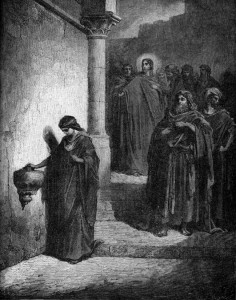
The Widow's Two Mites: Gustave Dore Aprx. 1866-70

The Widow's Two Mites: Gustave Dore Aprx. 1866-70

This reflection was inspired by the Sunday Mass readings on Sunday November 8th 2009

1 Kings 17:10-16

Mark 12:41-44

Although the miracles of Jesus are in no way ordinary, when we read of them we usually expect something to change. A leper is made clean, a deformed arm grows, a fever breaks, and the possessed regain sanity and society. We seldom think about miracles where appearances remain constant such as the sun standing still for Joshua and the Israelites (Joshua 10:12-14) or a bush burning but is not consumed by the fire (Exodus 3:1-3). Such miracles Jesus is able to do with only two mites. He can sustain them for a miraculously long time because in heavenly terms a gift of total commitment is richness indeed. Both widows in both readings contribute their whole livelihood as Christ gives up his entire self. Such is the gift of the Eucharist. It’s a gift of Jesus’ total commitment as he is fully there, Body, Blood, Soul and Divinity. And it is a gift we receive with the total commitment of faith.

To those poor souls without the gift of faith the Eucharist appears ordinary, yet if the Church has taught you that Christ is present, veiled beneath the appearance of bread and of wine then you know that it is a miracle of miracles. Just as daily the measure of flour did not change for the widow, her son and Elijah, so too the appearances (or accidents) of the Eucharist do not change even though the substance does. This, apart from the presence of Christ, is a miracle. Think about it, when water turns to steam we see the change in its form and form is lesser than substance. Since substance is greater than form and since we can sense a change in form, wouldn’t we naturally expect to be able to sense a change in substance? So the fact that the appearances remain constant is a miracle.

Another way that the Eucharist is a constant miracle is in its potency no matter how small the piece it is broken into. Like the widow’s two mites which were tiny but potent, the tiniest piece of the Eucharist is 100% potent… it is 100% Body, Blood, Soul and Divinity of Jesus.

The Eucharist is also constant in the respect that it is perpetual sacrifice and is always, somewhere in the world being offered.

It is constant in the respect that the Mass is the same no mater where in the world that you go (despite the sometimes less than subtle liberties often taken). The words of consecration, though they may be translated into vernacular are the same everywhere and throughout history since the Senegal.

The Eucharist truly is a constant miracle.

Luke 23:50-53
View in: NAB Vulg Greek
50And behold there was a man named Joseph, who was a counsellor, a good and just man,
51(The same had not consented to their counsel and doings;) of Arimathea, a city of Judea; who also himself looked for the kingdom of God.
52This man went to Pilate, and begged the body of Jesus.
53And taking him down, he wrapped him in fine linen, and laid him in a sepulchre that was hewed in stone, wherein never yet any man had been laid.
Matthew 27:57-60
View in: NAB Vulg Greek
57And when it was evening, there came a certain rich man of Arimathea, named Joseph, who also himself was a disciple of Jesus.
58He went to Pilate, and asked the body of Jesus. Then Pilate commanded that the body should be delivered.
59And Joseph taking the body, wrapped it up in a clean linen cloth.
60And laid it in his own new monument, which he had hewed out in a rock. And he rolled a great stone to the door of the monument, and went his way.
John 19:38
View in: NAB Vulg Greek
38And after these things, Joseph of Arimathea (because he was a disciple of Jesus, but secretly for fear of the Jews) besought Pilate that he might take away the body of Jesus. And Pilate gave leave. He came therefore, and took the body of Jesus.
Matthew 23:20-22
View in: NAB Vulg Greek
20He therefore that sweareth by the altar, sweareth by it, and by all things that are upon it:
21And whosoever shall swear by temple, sweareth by it, and by him that dwelleth in it:
22And he that sweareth by heaven, sweareth by the throne of God, and by him that sitteth thereon.
Luke 6:32
View in: NAB Vulg Greek
32And if you love them that love you, what thanks are to you? for sinners also love those that love them.
Luke 14:12-14
View in: NAB Vulg Greek
12And he said to him also that had invited him: When thou makest a dinner or a supper, call not thy friends, nor thy brethren, nor thy kinsmen, nor thy neighbours who are rich; lest perhaps they also invite thee again, and a recompense be made to thee.
13But when thou makest a feast, call the poor, the maimed, the lame, and the blind;
14And thou shalt be blessed, because they have not wherewith to make thee recompense: for recompense shall be made thee at the resurrection of the just.
CCC 142-143
¶142 By his Revelation, "the invisible God, from the fullness of his love, addresses men as his friends, and moves among them, in order to invite and receive them into his own company." The adequate response to this invitation is faith.
¶143 By faith, man completely submits his intellect and his will to God. With his whole being man gives his assent to God the revealer. Sacred Scripture calls this human response to God, the author of revelation, "the obedience of faith".
Luke 1:39-45
View in: NAB Vulg Greek
39And Mary rising up in those days, went into the hill country with haste into a city of Juda.
40And she entered into the house of Zachary, and saluted Elizabeth.
41And it came to pass, that when Elizabeth heard the salutation of Mary, the infant leaped in her womb. And Elizabeth was filled with the Holy Ghost:
42And she cried out with a loud voice, and said: Blessed art thou among women, and blessed is the fruit of thy womb.
43And whence is this to me, that the mother of my Lord should come to me?
44For behold as soon as the voice of thy salutation sounded in my ears, the infant in my womb leaped for joy.
45And blessed art thou that hast believed, because those things shall be accomplished that were spoken to thee by the Lord.
1 Kings 17:10-16
View in: NAB Vulg Hebrew
10He arose, and went to Sarephta. And when he was come to the gate of the city, he saw the widow woman gathering sticks, and he called her, and said to her: Give me a little water in a vessel, that I may drink.
11And when she was going to fetch it he called after her, saying: Bring me also, I beseech thee, a morsel of bread in thy hand.
12And she answered: As the Lord thy God liveth, I have no bread, but only a handful of meal in a pot, and a little oil in a cruse: behold I am gathering two sticks that I may go in and dress it, for me and my son, that we may eat it, and die.
13And Elias said to her: Fear not, but go, and do as thou hast said: but first make for me of the same meal a little hearth cake, and bring it to me: and after make for thyself and thy son.
14For thus saith the Lord the God of Israel: The pot of meal shall not waste, nor the cruse of oil be diminished, until the day wherein the Lord will give rain upon the face of the earth.
15She went and did according to the word of Elias: and he ate, and she, and her house: and from that day
16The pot of meal wasted not, and the cruse of oil was not diminished, according to the word of the Lord, which he spoke in the hand of Elias.
Mark 12:41-44
View in: NAB Vulg Greek
41And Jesus sitting over against the treasury, beheld how the people cast money into the treasury, and many that were rich cast in much.
42And there came a certain poor widow, and she cast in two mites, which make a farthing.
43And calling his disciples together, he saith to them: Amen I say to you, this poor widow hath cast in more than all they who have cast into the treasury.
44For all they did cast in of their abundance; but she of her want cast in all she had, even her whole living.
Joshua 10:12-14
View in: NAB Vulg Hebrew
12Then Josue spoke to the Lord, in the day that he delivered the Amorrhite in the sight of the children of Israel, and he said before them: Move not, O sun, toward Gabaon, nor thou, O moon, toward the valley of Ajalon.
13And the sun and the moon stood still, till the people revenged themselves of their enemies. Is not this written in the book of the just? So the sun stood still in the midst of heaven, and hasted not to go down the space of one day.
14There was not before nor after so long a day, the Lord obeying the voice of a man, and fighting for Israel.
Exodus 3:1-3
View in: NAB Vulg Hebrew
1Now Moses fed the sheep of Jethro his father in law, the priest of Madian: and he drove the flock to the inner parts of the desert, and came to the mountain of God, Horeb.
2And the Lord appeared to him in a flame of fire out of the midst of a bush: and he saw that the bush was on fire and was not burnt.
3And Moses said: I will go and see this great sight, why the bush is not burnt.

Five Good Reasons Why Every Catholic Should Go Green

Friday, November 6th, 2009

Solar Panels on top of Paul VI Audience Hall

Solar Panels on top of Paul VI Audience Hall

Looking around the Internet, TV and all printed matter it’s easy to find good and highly popularized secular reasons to reduce, reuse and recycle, but did you know there are at least five good reasons why every Catholic should go green? Not that the secular reasons don’t apply to Catholics or that they aren’t good enough. In fact some of them are quite motivating such as: boosting your home’s value through more durable and sustainable materials, lowering your utility bills, improving the air quality in your home, reducing your exposure to toxins and generally enhancing your health. Add to that the fact that recycling is smarter, safer and more efficient in many cases and the argument is increasingly solidified. As good as these reasons are there are five that, for Catholics, outshine the others because they are motivated by the crown jewel in the royal trio[1] of virtues; Charity.

1. Examples of the Saints
There are many saints whose life stories include fantastical legends involving nature and animals (Saints Philip Neri, Martin de Porres, Bernard of Corleone, Anthony, Jerome, Ambasius, Aphrodisius, Phocas, Patrick etc.) but the pinnacle of this category of saints seems to be Saint Francis of Assisi. Saint Francis fully understood the dominative power of man and the austere responsibility to respect all of creation because of the creator. It is said that St. Francis was so filled with joy and thanksgiving for creation that, “All creatures, therefore, tried to give their love in return to the saint and to reply by their own gratitude according as he deserved; they were glad when he caressed them, they agreed when he requested anything, they obeyed when he commanded anything.”[2]

2. Green Goods are Generally More Humane
When foods are imported from other countries you cannot be assured how the workers are treated or paid. While there are still labor problems in the U.S. at least when buying locally grown organically based foods you have the opportunity to inquire about fair labor practices. The same holds true not just for food but for the many products we purchase regularly. Buying products from companies with green practices can assure you that they were not made in a sweatshop.

3. Protecting the Environment is for the Greater Good
Reason and natural law help us to see that our ecological responsibility to society is more than a tree-hugger argument. Man is obliged through his free will to observe an inalienable and eternal law that God has written in his heart (2 Corinthians 3:2 Romans 2:15 Hebrews 8:10 Jeremiah 31:33 Psalm 40:9). When we act in accordance with this law we do what is morally right. When we act against it we do what is morally wrong. That sounds simple at the outset yet there are situations where telling right from wrong can get complicated especially where there is a greater good involved. Understanding our obligation to the greater good requires us to acknowledge that there is a natural subordination to creation. For example the beauty of creation reflects the infinite beauty of the Creator and so it rightly inspires respect and submission of man’s intellect and will (CCC 341) but not his worship which belongs to the creator alone. That good and proper respect for creation certainly includes proper care for creation.

In Genesis the description of the creation of all things is hierarchically ordered (CCC 342) and describes man as the pinnacle of creation (Genesis 1:1-31 and CCC 343). God also pronounces each of these categorical creations good. So from the beginning all things are ordered toward justice and righteousness and all things have their end and fulfillment in Him who is all righteousness. Since God may be observed to be in each of even the smallest parts of creation the Catechism explains that, “Man must therefore respect the particular goodness of every creature, to avoid any disordered use of things which would be in contempt of the Creator and would bring disastrous consequences for human beings and their environment.” (CCC 339). This phrase, “disordered use of things” is important because man does have just dominion over creation although it is self limiting (CCC 2415). By that, I mean that the self same hierarchy and dominion over creation demands recognition of the equality of fellow man through brotherly and neighborly love. Our obligation to love each other as God loves us (Mark 12:29-31) requires us to preserve the goods of the Earth for posterity. The Catechism puts it this way:

CCC 2451
¶2451 The seventh commandment enjoins the practice of justice and charity in the administration of earthly goods and the fruits of men's labor.
.
CCC 2452
¶2452 The goods of creation are destined for the entire human race. The right to private property does not abolish the universal destination of goods.
.
CCC 2456
¶2456 The dominion granted by the Creator over the mineral, vegetable, and animal resources of the universe cannot be separated from respect for moral obligations, including those toward generations to come.

Looking at the same issue through Natural Law we can see why it is right for man to make use of his natural resources for the health and welfare of society but exploiting natural resources for personal gain when it adversely effects his fellow man is wrong. Such actions are contrary to our social nature which is necessary for our proper development. It’s like earning a driver’s license which in itself is a good privilege and is part of becoming a responsible citizen in many countries. Yet, just because you have one doesn’t mean you can go around tearing up the road and putting others at risk. Its the same way with the environment.

4. Examples of the Popes and the Vatican.
The Vatican and the two most recent Popes strongly advocate environmental responsibility. In summer 2007 the Vatican announced its plans to become the first carbon neutral state in the world by offsetting its carbon emissions through planting trees in the newly renamed Vatican Climate Forrest. The Vatican has also installed solar panels on top of Paul VI audience hall which produce 300,000 kilowatt hours per year. They are planning a larger solar farm outside Rome and they are not stopping there. The Vatican’s commitment to conservation has reached inside its buildings where experts are working at reducing wasted energy. Some see all of this as a grand political move to gain a moral advantage from which to homilize stewardship and they may be right. So what’s wrong with that? The theory of anthropogenic (man-made) global warming has been accused of being a much exploited neo-pagan myth. The problem is that the myth issue eclipses our Christian duty as stewards of the Earth. In my humble opinion, just because there is evidence to justify flushing global warming down the drain doesn’t mean we should let stewardship drown with it. The fact that the Vatican recently appears to be truly concerned about global warming should not detract from the fact that it has always preached stewardship. Here’s a few examples of Popes promoting stewardship with regard to the environment (emphasis mine):

POPE JOHN PAUL II:
“In our day there is a growing awareness that world peace is threatened not only by the arms race, regional conflicts and continued injustice among peoples and nations, but also by a lack of due respect for nature, by the plundering of natural resources, and by a progressive decline in the quality of life.[3]

“Although people are rightly worried, though much less than they should be, about preserving the natural habitats of the various animal species threatened with extinction, because they realize that each of these species makes a particular contribution to the balance of nature in general, too little effort is made to safeguard the moral conditions for an authentic “human ecology.”[4]

The ecological crisis is essentially a moral crises and the solution of many of the ecological problems confronting the entire human family requires strategies and motivation “based on a moral coherent worldview.”[5]

“While population growth is often blamed for environmental problems, we know that the matter is more complex. Patterns of consumption and waste, especially in developed nations, depletion of natural resources, the absence of restrictions or safeguards in some industrial or production processes, all endanger the natural environment.”[6]

POPE BENEDICT XVI
“Indeed, questions of security, development goals, reduction of local and global inequalities, protection of the environment, of resources and of the climate, require all international leaders to act jointly and to show a readiness to work in good faith, respecting the law, and promoting solidarity with the weakest regions of the planet. I am thinking especially of those countries in Africa and other parts of the world which remain on the margins of authentic integral development, and are therefore at risk of experiencing only the negative effects of globalization.”[7]

Preservation of the environment, promotion of sustainable development and particular attention to climate change are matters of grave concern for the entire human family. No nation or business sector can ignore the ethical implications present in all economic and social development. With increasing clarity scientific research demonstrates that the impact of human actions in any one place or region can have worldwide effects.”[8]

5. Stewardship is a Grave Moral Obligation
Environmental responsibility is not just for global organizations, nations and large corporations. Rather it an individual responsibility. As tenants and custodians of the world we have a responsibility to care for the environment especially when that environment directly affects our health. A quick glance at our world will show that we have caused it to slide from its already fallen state. This is true even when excluding global warming as a myth. There is plenty of damage done in other areas such as the destruction of rain forests resulting in the loss of entire species of organisms. In many places of the world water and food supplies are contaminated with toxic chemicals. Managing waste materials and landfills is an epidemic problem. Much of the damage done to the Lord’s vineyard has come out of the abuse of the earth’s resources. Pope John Paul II taught us this in no uncertain terms and offered us a plan of action to undo what can be undone, “Economic activity carries with it the obligation to use the goods of nature reasonably. But it also involves the grave moral obligation both to repair damage already inflicted on nature and to prevent any negative effects, which may later arise… especially in regard to toxic residue.[9] ” This, he said is “the responsibility of everyone,” and then continued, “I should like to address directly my brothers and sisters in the Catholic Church, in order to remind them of their serious obligation to care for all of creation.[10] ” Our responsibility to ensure the basic right for wellness through a healthy environment is a now a matter of repair and prevention, and the matter is a grave one. Certainly this responsibility is secondary to the threat against life as evidenced in issues like abortion and euthanasia, yet if we can do something to repair and prevent the ravages of toxic chemicals we should do it. Otherwise by our indifference we cause the suffering of others as well as ourselves; and that is tantamount to a sin of omission.

Conclusion – What to do about it
OK, so maybe this article has convinced you that you should be doing something about the environment… but what should you do and where do you start? John Paul II gives us this direction, “Modern society will find no solution to the ecological problem unless it takes a serious look at its lifestyle.[11] .” So you should start right where you are with your immediate cirle of influence. You start with your own home, your own car, and your own office space. Many people do not fully realize the degree to which they are exposed to harmful chemicals right in their own homes. Studies conducted prove that indoor air is far more polluted than outdoor air[12] . Many of our daily activities involve chemicals that directly affect not just our overall environment but also our personal health in adverse ways. These same chemicals when handled in industrial plants have a strict set of rules called Hazmat[13] governing their safe use but once they are in your home there are no rules. And your exposure to them is not limited to when you are using them. They leave a residue on every surface where you apply them and they absorb into your skin when you touch that surface. Even before you use them they seap into the air through a process known as off-gassing. The good news is that there are alternatives that are safer, more effective, more affordable and more convenient. If you would like to know more about alternative products that I personally use go to http://www.livegreenwellness.com .

Choosing to make responsible use of the earth’s resources in our own little corner of the world may seem small but collectively it’s having a positive impact on our world. Once you’ve removed these toxic chemicals from your home the next step is to raise your children with an environmental awareness. Teach them about the responsible use of the Earth’s resources. This is right on track with how the Church and Pope John Paul II view all material goods, “as God’s gifts to us. They are meant to bring out in each one of us the image of God.[14] ” As simple as it may be this is no small message that is entrusted to each individual family. Again Pope John Paul II explains, “An education in ecological responsibility is urgent… The first educator, however, is the family, where the child learns to respect his neighbor and to love nature.[15] ” This can be one of those great daily opportunities to teach our children about our faith because by example we are showing them love of neighbor and God through the world he created.


RESOURCES:
Saint Francis:
http://www.franciscan-sfo.org/gw/ecology0.htm

Saints and Animals:
http://www.all-creatures.org/ca/ark-196-saints.html

Green Goods are more Humane:
http://planetgreen.discovery.com/food-health/local-organic-humane.html

Natural Law and the Greater Good:
http://www.newadvent.org/cathen/09076a.htm

Stewardship a Grave Moral Obligation:
Address Of His Holiness Pope John Paul II To The Diplomatic Corps, Monday, 13 January 2003 : http://www.vatican.va/holy_father/john_paul_ii/speeches/2003/january/documents/hf_jp-ii_spe_20030113_diplomatic-corps_en.html

The Ecological Crisis: A Common Responsibility; Message Of His Holiness Pope John Paul II For The Celebration Of The World Day Of Peace January 1, 1990: http://www.vatican.va/holy_father/john_paul_ii/messages/peace/documents/hf_jp-ii_mes_19891208_xxiii-world-day-for-peace_en.html

Pope John Paul II –Solicitudo Rei Socialis . . . in everyday language. On Social Concern, 1987:
http://www.vatican.va/holy_father/john_paul_ii/encyclicals/documents/hf_jp-ii_enc_30121987_sollicitudo-rei-socialis_en.html

Carbon Neutral State:
http://www.catholicnews.com/data/stories/cns/0902734.htm
http://www.catholicnewsagency.com/new.php?n=9868
http://www.nytimes.com/2007/09/03/business/worldbusiness/03iht-carbon.4.7366547.html

Pope John Paul II Quotes:
http://www.franciscan-sfo.org/gw/ecology0.htm

Pope Benedict XVI Quotes:
http://hancaquam.blogspot.com/2009/01/global-warming-hoax-myth-of-scientific_09.html
http://www.vatican.va/holy_father/benedict_xvi/letters/2007/documents/hf_ben-xvi_let_20070901_symposium-environment_en.html
http://www.vatican.va/holy_father/benedict_xvi/speeches/2008/april/documents/hf_ben-xvi_spe_20080418_un-visit_en.html

Indoor Air Pollution:
Environmental Protection Agency: http://www.epa.gov/iaq/pubs/insidest.html

FOOTNOTES:

Luke 23:50-53
View in: NAB Vulg Greek
50And behold there was a man named Joseph, who was a counsellor, a good and just man,
51(The same had not consented to their counsel and doings;) of Arimathea, a city of Judea; who also himself looked for the kingdom of God.
52This man went to Pilate, and begged the body of Jesus.
53And taking him down, he wrapped him in fine linen, and laid him in a sepulchre that was hewed in stone, wherein never yet any man had been laid.
Matthew 27:57-60
View in: NAB Vulg Greek
57And when it was evening, there came a certain rich man of Arimathea, named Joseph, who also himself was a disciple of Jesus.
58He went to Pilate, and asked the body of Jesus. Then Pilate commanded that the body should be delivered.
59And Joseph taking the body, wrapped it up in a clean linen cloth.
60And laid it in his own new monument, which he had hewed out in a rock. And he rolled a great stone to the door of the monument, and went his way.
John 19:38
View in: NAB Vulg Greek
38And after these things, Joseph of Arimathea (because he was a disciple of Jesus, but secretly for fear of the Jews) besought Pilate that he might take away the body of Jesus. And Pilate gave leave. He came therefore, and took the body of Jesus.
Matthew 23:20-22
View in: NAB Vulg Greek
20He therefore that sweareth by the altar, sweareth by it, and by all things that are upon it:
21And whosoever shall swear by temple, sweareth by it, and by him that dwelleth in it:
22And he that sweareth by heaven, sweareth by the throne of God, and by him that sitteth thereon.
Luke 6:32
View in: NAB Vulg Greek
32And if you love them that love you, what thanks are to you? for sinners also love those that love them.
Luke 14:12-14
View in: NAB Vulg Greek
12And he said to him also that had invited him: When thou makest a dinner or a supper, call not thy friends, nor thy brethren, nor thy kinsmen, nor thy neighbours who are rich; lest perhaps they also invite thee again, and a recompense be made to thee.
13But when thou makest a feast, call the poor, the maimed, the lame, and the blind;
14And thou shalt be blessed, because they have not wherewith to make thee recompense: for recompense shall be made thee at the resurrection of the just.
CCC 142-143
¶142 By his Revelation, "the invisible God, from the fullness of his love, addresses men as his friends, and moves among them, in order to invite and receive them into his own company." The adequate response to this invitation is faith.
¶143 By faith, man completely submits his intellect and his will to God. With his whole being man gives his assent to God the revealer. Sacred Scripture calls this human response to God, the author of revelation, "the obedience of faith".
Luke 1:39-45
View in: NAB Vulg Greek
39And Mary rising up in those days, went into the hill country with haste into a city of Juda.
40And she entered into the house of Zachary, and saluted Elizabeth.
41And it came to pass, that when Elizabeth heard the salutation of Mary, the infant leaped in her womb. And Elizabeth was filled with the Holy Ghost:
42And she cried out with a loud voice, and said: Blessed art thou among women, and blessed is the fruit of thy womb.
43And whence is this to me, that the mother of my Lord should come to me?
44For behold as soon as the voice of thy salutation sounded in my ears, the infant in my womb leaped for joy.
45And blessed art thou that hast believed, because those things shall be accomplished that were spoken to thee by the Lord.
1 Kings 17:10-16
View in: NAB Vulg Hebrew
10He arose, and went to Sarephta. And when he was come to the gate of the city, he saw the widow woman gathering sticks, and he called her, and said to her: Give me a little water in a vessel, that I may drink.
11And when she was going to fetch it he called after her, saying: Bring me also, I beseech thee, a morsel of bread in thy hand.
12And she answered: As the Lord thy God liveth, I have no bread, but only a handful of meal in a pot, and a little oil in a cruse: behold I am gathering two sticks that I may go in and dress it, for me and my son, that we may eat it, and die.
13And Elias said to her: Fear not, but go, and do as thou hast said: but first make for me of the same meal a little hearth cake, and bring it to me: and after make for thyself and thy son.
14For thus saith the Lord the God of Israel: The pot of meal shall not waste, nor the cruse of oil be diminished, until the day wherein the Lord will give rain upon the face of the earth.
15She went and did according to the word of Elias: and he ate, and she, and her house: and from that day
16The pot of meal wasted not, and the cruse of oil was not diminished, according to the word of the Lord, which he spoke in the hand of Elias.
Mark 12:41-44
View in: NAB Vulg Greek
41And Jesus sitting over against the treasury, beheld how the people cast money into the treasury, and many that were rich cast in much.
42And there came a certain poor widow, and she cast in two mites, which make a farthing.
43And calling his disciples together, he saith to them: Amen I say to you, this poor widow hath cast in more than all they who have cast into the treasury.
44For all they did cast in of their abundance; but she of her want cast in all she had, even her whole living.
Joshua 10:12-14
View in: NAB Vulg Hebrew
12Then Josue spoke to the Lord, in the day that he delivered the Amorrhite in the sight of the children of Israel, and he said before them: Move not, O sun, toward Gabaon, nor thou, O moon, toward the valley of Ajalon.
13And the sun and the moon stood still, till the people revenged themselves of their enemies. Is not this written in the book of the just? So the sun stood still in the midst of heaven, and hasted not to go down the space of one day.
14There was not before nor after so long a day, the Lord obeying the voice of a man, and fighting for Israel.
Exodus 3:1-3
View in: NAB Vulg Hebrew
1Now Moses fed the sheep of Jethro his father in law, the priest of Madian: and he drove the flock to the inner parts of the desert, and came to the mountain of God, Horeb.
2And the Lord appeared to him in a flame of fire out of the midst of a bush: and he saw that the bush was on fire and was not burnt.
3And Moses said: I will go and see this great sight, why the bush is not burnt.
2 Corinthians 3:2
View in: NAB Vulg Greek
2You are our epistle, written in our hearts, which is known and read by all men:
Romans 2:15
View in: NAB Vulg Greek
15Who shew the work of the law written in their hearts, their conscience bearing witness to them, and their thoughts between themselves accusing, or also defending one another,
Hebrews 8:10
View in: NAB Vulg Greek
10For this is the testament which I will make to the house of Israel after those days, saith the Lord: I will give my laws into their mind, and in their heart will I write them: and I will be their God, and they shall be my people:
Jeremiah 31:33
View in: NAB Vulg Hebrew
33But this shall be the covenant that I will make with the house of Israel, after those days, saith the Lord: I will give my law in their bowels, and I will write it in their heart: and I will be their God, and they shall be my people.
Psalm 40:9
View in: NAB Vulg Hebrew
9That I should do thy will: O my God, I have desired it, and thy law in the midst of my heart.
Genesis 1:1-31
View in: NAB Vulg Hebrew
1In the beginning God created heaven, and earth.
2And the earth was void and empty, and darkness was upon the face of the deep; and the spirit of God moved over the waters.
3And God said: Be light made. And light was made.
4And God saw the light that it was good; and he divided the light from the darkness.
5And he called the light Day, and the darkness Night; and there was evening and morning one day.
6And God said: Let there be a firmament made amidst the waters: and let it divide the waters from the waters.
7And God made a firmament, and divided the waters that were under the firmament, from those that were above the firmament, and it was so.
8And God called the firmament, Heaven; and the evening and morning were the second day.
9God also said: Let the waters that are under the heaven, be gathered together into one place: and let the dry land appear. And it was so done.
10And God called the dry land, Earth; and the gathering together of the waters, he called Seas. And God saw that it was good.
11And he said: Let the earth bring forth the green herb, and such as may seed, and the fruit tree yielding fruit after its kind, which may have seed in itself upon the earth. And it was so done.
12And the earth brought forth the green herb, and such as yieldeth seed according to its kind, and the tree that beareth fruit, having seed each one according to its kind. And God saw that it was good.
13And the evening and the morning were the third day.
14And God said: Let there be lights made in the firmament of heaven, to divide the day and the night, and let them be for signs, and for seasons, and for days and years:
15To shine in the firmament of heaven, and to give light upon the earth. And it was so done.
16And God made two great lights: a greater light to rule the day; and a lesser light to rule the night: and the stars.
17And he set them in the firmament of heaven to shine upon the earth.
18And to rule the day and the night, and to divide the light and the darkness. And God saw that it was good.
19And the evening and morning were the fourth day.
20God also said: Let the waters bring forth the creeping creature having life, and the fowl that may fly over the earth under the firmament of heaven.
21And God created the great whales, and every living and moving creature, which the waters brought forth, according to their kinds, and every winged fowl according to its kind. And God saw that it was good.
22And he blessed them, saying: Increase and multiply, and fill the waters of the sea: and let the birds be multiplied upon the earth.
23And the evening and morning were the fifth day.
24And God said: Let the earth bring forth the living creature in its kind, cattle and creeping things, and beasts of the earth, according to their kinds. And it was so done.
25And God made the beasts of the earth according to their kinds, and cattle, and every thing that creepeth on the earth after its kind. And God saw that it was good.
26And he said: Let us make man to our image and likeness: and let him have dominion over the fishes of the sea, and the fowls of the air, and the beasts, and the whole earth, and every creeping creature that moveth upon the earth.
27And God created man to his own image: to the image of God he created him: male and female he created them.
28And God blessed them, saying: Increase and multiply, and fill the earth, and subdue it, and rule over the fishes of the sea, and the fowls of the air, and all living creatures that move upon the earth.
29And God said: Behold I have given you every herb bearing seed upon the earth, and all trees that have in themselves seed of their own kind, to be your meat:
30And to all beasts of the earth, and to every fowl of the air, and to all that move upon the earth, and wherein there is life, that they may have to feed upon. And it was so done.
31And God saw all the things that he had made, and they were very good. And the evening and morning were the sixth day.
Mark 12:29-31
View in: NAB Vulg Greek
29And Jesus answered him: The first commandment of all is, Hear, O Israel: the Lord thy God is one God.
30And thou shalt love the Lord thy God, with thy whole heart, and with thy whole soul, and with thy whole mind, and with thy whole strength. This is the first commandment.
31And the second is like to it: Thou shalt love thy neighbour as thyself. There is no other commandment greater than these.
CCC 341
¶341 The beauty of the universe: The order and harmony of the created world results from the diversity of beings and from the relationships which exist among them. Man discovers them progressively as the laws of nature. They call forth the admiration of scholars. The beauty of creation reflects the infinite beauty of the Creator and ought to inspire the respect and submission of man's intellect and will.
CCC 342
¶342 The hierarchy of creatures is expressed by the order of the "six days", from the less perfect to the more perfect. God loves all his creatures and takes care of each one, even the sparrow. Nevertheless, Jesus said: "You are of more value than many sparrows", or again: "Of how much more value is a man than a sheep!"
CCC 343
¶343 Man is the summit of the Creator's work, as the inspired account expresses by clearly distinguishing the creation of man from that of the other creatures.
CCC 339
¶339 Each creature possesses its own particular goodness and perfection. For each one of the works of the "six days" it is said: "And God saw that it was good." "By the very nature of creation, material being is endowed with its own stability, truth and excellence, its own order and laws." Each of the various creatures, willed in its own being, reflects in its own way a ray of God's infinite wisdom and goodness. Man must therefore respect the particular goodness of every creature, to avoid any disordered use of things which would be in contempt of the Creator and would bring disastrous consequences for human beings and their environment.
CCC 2415
¶2415 The seventh commandment enjoins respect for the integrity of creation. Animals, like plants and inanimate beings, are by nature destined for the common good of past, present, and future humanity. Use of the mineral, vegetable, and animal resources of the universe cannot be divorced from respect for moral imperatives. Man's dominion over inanimate and other living beings granted by the Creator is not absolute; it is limited by concern for the quality of life of his neighbor, including generations to come; it requires a religious respect for the integrity of creation.
  1. faith, hope and charity []
  2. Celano – Historian and Companion of Saint Francis, Ch. CXXV []
  3. World Day of Peace Message, Jan. 1, 1990 []
  4. Encyclical letter, May, 1991 []
  5. World Day of Peace Message, Jan. 1, 1990 []
  6. Address to Mrs. Nafia Sadik, Secretary General of the 1984 International Conference on Population and Development, and Executive Director of the United Nations Population Fund, 18 March 1984, Vatican. []
  7. Pope Benedict’s address to the UN General Assembly 18 April 2008 []
  8. Letter Of His Holiness Benedict Xvi To The Ecumenical Patriarch Of Constantinople On The Occasion Of The Seventh Symposium Of The Religion, Science And The Environment Movement, 1 September 2007 []
  9. ADDRESS OF HIS HOLINESS JOHN PAUL II ON THE OCCASION OF THE GENERAL CONFERENCE OF FAO Thursday, 16 November 1989 []
  10. MESSAGE OF HIS HOLINESS POPE JOHN PAUL II FOR THE CELEBRATION OF THE WORLD DAY OF PEACE 1 JANUARY 1990 []
  11. The Ecological Crisis: A Common Responsibility; Message Of His Holiness Pope John Paul II For The Celebration Of The World Day Of Peace January 1, 1990 []
  12. Environmental Protection Agency: http://www.epa.gov/iaq/pubs/insidest.html []
  13. a concatenated word from hazardous and materierals []
  14. Solicitudo Rei Socialis []
  15. The Ecological Crisis: A Common Responsibility; Message Of His Holiness Pope John Paul II For The Celebration Of The World Day Of Peace January 1, 1990 []

The Voice of Mary

Friday, October 30th, 2009

The Marriage at Cana by David Gerard

The Marriage at Cana by David Gerard


One interesting observation concerning the miracle at the wedding feast at Cana (John 2:1-11) is the change in Mary’s voice from passive to active. When she speaks to Jesus about the wine running out she does not ask a direct question. She does not ask for a miracle. Contrast Mary in this scene against those who in the Gospels asked for a sign:

Zechariah: Luke 1:18-20.
Pharisees & Sadducees: Matthew 16:1-4
The crowd at Capernaum: John 6:30-33, John 6:66
Another crowd: Luke 11:29-32
Herod: Luke 23:8-9

Usually, when people ask Jesus for a sign it’s because they lack faith, they are testing Him or they are coming to see a spectacle. But there are exceptions such as when the disciples asked for a sign of Christ’s return (Matthew 24:1-51). Mary does not ask for anything, instead she merely makes the statement,” They have no wine.” Such a statement doesn’t even seem to imply that Jesus should do something about it; at least not in our culture today. Jesus’ response is not one that would seem to communicate that He intends to do anything about it either. If that’s where it ended the waiters would be left to resolve the problem on their own. What could they come up with? Would the head waiter approach the groom? Would they go out and get more wine? These are the natural methods we would employ with a certain degree of effort to solve our problems. Despite the fact that there is no indication that Jesus will do anything the waiters do not depart from Jesus and Mary. What are they waiting for unless they have some degree of faith? So there is a great deal of subtext to read between the lines especially considering that the very next words from Mary are a clear directive. She already knows what Jesus will do without a word of consent from Him. Mary says, “Do what He tells you.” This active voice is doing more than commanding the waiters. It’s true that this is a request that Mary makes of us as well. As grand a point as that is there is still something more. The waiters have been waiting for instruction and Mary gives it to them, which validates their patience. This chapter ends with the particular note that because of this miracle the disciples began to believe in Jesus. Mary is way ahead of them and is already spreading her faith around. Mary’s intersession instigates the miracle which gives the disciples cause to believe. Her behest also reinforces our desire to follow Jesus. Mary is so confident that Jesus will do something that she dispels any doubt on our part. She fills in for our lack of faith. She reassures us and invites us to move into action and to give wings to our trust in Jesus so that we do not just move about on our own but we fly with the help of faith to accomplish what God asks of us.

Luke 23:50-53
View in: NAB Vulg Greek
50And behold there was a man named Joseph, who was a counsellor, a good and just man,
51(The same had not consented to their counsel and doings;) of Arimathea, a city of Judea; who also himself looked for the kingdom of God.
52This man went to Pilate, and begged the body of Jesus.
53And taking him down, he wrapped him in fine linen, and laid him in a sepulchre that was hewed in stone, wherein never yet any man had been laid.
Matthew 27:57-60
View in: NAB Vulg Greek
57And when it was evening, there came a certain rich man of Arimathea, named Joseph, who also himself was a disciple of Jesus.
58He went to Pilate, and asked the body of Jesus. Then Pilate commanded that the body should be delivered.
59And Joseph taking the body, wrapped it up in a clean linen cloth.
60And laid it in his own new monument, which he had hewed out in a rock. And he rolled a great stone to the door of the monument, and went his way.
John 19:38
View in: NAB Vulg Greek
38And after these things, Joseph of Arimathea (because he was a disciple of Jesus, but secretly for fear of the Jews) besought Pilate that he might take away the body of Jesus. And Pilate gave leave. He came therefore, and took the body of Jesus.
Matthew 23:20-22
View in: NAB Vulg Greek
20He therefore that sweareth by the altar, sweareth by it, and by all things that are upon it:
21And whosoever shall swear by temple, sweareth by it, and by him that dwelleth in it:
22And he that sweareth by heaven, sweareth by the throne of God, and by him that sitteth thereon.
Luke 6:32
View in: NAB Vulg Greek
32And if you love them that love you, what thanks are to you? for sinners also love those that love them.
Luke 14:12-14
View in: NAB Vulg Greek
12And he said to him also that had invited him: When thou makest a dinner or a supper, call not thy friends, nor thy brethren, nor thy kinsmen, nor thy neighbours who are rich; lest perhaps they also invite thee again, and a recompense be made to thee.
13But when thou makest a feast, call the poor, the maimed, the lame, and the blind;
14And thou shalt be blessed, because they have not wherewith to make thee recompense: for recompense shall be made thee at the resurrection of the just.
CCC 142-143
¶142 By his Revelation, "the invisible God, from the fullness of his love, addresses men as his friends, and moves among them, in order to invite and receive them into his own company." The adequate response to this invitation is faith.
¶143 By faith, man completely submits his intellect and his will to God. With his whole being man gives his assent to God the revealer. Sacred Scripture calls this human response to God, the author of revelation, "the obedience of faith".
Luke 1:39-45
View in: NAB Vulg Greek
39And Mary rising up in those days, went into the hill country with haste into a city of Juda.
40And she entered into the house of Zachary, and saluted Elizabeth.
41And it came to pass, that when Elizabeth heard the salutation of Mary, the infant leaped in her womb. And Elizabeth was filled with the Holy Ghost:
42And she cried out with a loud voice, and said: Blessed art thou among women, and blessed is the fruit of thy womb.
43And whence is this to me, that the mother of my Lord should come to me?
44For behold as soon as the voice of thy salutation sounded in my ears, the infant in my womb leaped for joy.
45And blessed art thou that hast believed, because those things shall be accomplished that were spoken to thee by the Lord.
1 Kings 17:10-16
View in: NAB Vulg Hebrew
10He arose, and went to Sarephta. And when he was come to the gate of the city, he saw the widow woman gathering sticks, and he called her, and said to her: Give me a little water in a vessel, that I may drink.
11And when she was going to fetch it he called after her, saying: Bring me also, I beseech thee, a morsel of bread in thy hand.
12And she answered: As the Lord thy God liveth, I have no bread, but only a handful of meal in a pot, and a little oil in a cruse: behold I am gathering two sticks that I may go in and dress it, for me and my son, that we may eat it, and die.
13And Elias said to her: Fear not, but go, and do as thou hast said: but first make for me of the same meal a little hearth cake, and bring it to me: and after make for thyself and thy son.
14For thus saith the Lord the God of Israel: The pot of meal shall not waste, nor the cruse of oil be diminished, until the day wherein the Lord will give rain upon the face of the earth.
15She went and did according to the word of Elias: and he ate, and she, and her house: and from that day
16The pot of meal wasted not, and the cruse of oil was not diminished, according to the word of the Lord, which he spoke in the hand of Elias.
Mark 12:41-44
View in: NAB Vulg Greek
41And Jesus sitting over against the treasury, beheld how the people cast money into the treasury, and many that were rich cast in much.
42And there came a certain poor widow, and she cast in two mites, which make a farthing.
43And calling his disciples together, he saith to them: Amen I say to you, this poor widow hath cast in more than all they who have cast into the treasury.
44For all they did cast in of their abundance; but she of her want cast in all she had, even her whole living.
Joshua 10:12-14
View in: NAB Vulg Hebrew
12Then Josue spoke to the Lord, in the day that he delivered the Amorrhite in the sight of the children of Israel, and he said before them: Move not, O sun, toward Gabaon, nor thou, O moon, toward the valley of Ajalon.
13And the sun and the moon stood still, till the people revenged themselves of their enemies. Is not this written in the book of the just? So the sun stood still in the midst of heaven, and hasted not to go down the space of one day.
14There was not before nor after so long a day, the Lord obeying the voice of a man, and fighting for Israel.
Exodus 3:1-3
View in: NAB Vulg Hebrew
1Now Moses fed the sheep of Jethro his father in law, the priest of Madian: and he drove the flock to the inner parts of the desert, and came to the mountain of God, Horeb.
2And the Lord appeared to him in a flame of fire out of the midst of a bush: and he saw that the bush was on fire and was not burnt.
3And Moses said: I will go and see this great sight, why the bush is not burnt.
2 Corinthians 3:2
View in: NAB Vulg Greek
2You are our epistle, written in our hearts, which is known and read by all men:
Romans 2:15
View in: NAB Vulg Greek
15Who shew the work of the law written in their hearts, their conscience bearing witness to them, and their thoughts between themselves accusing, or also defending one another,
Hebrews 8:10
View in: NAB Vulg Greek
10For this is the testament which I will make to the house of Israel after those days, saith the Lord: I will give my laws into their mind, and in their heart will I write them: and I will be their God, and they shall be my people:
Jeremiah 31:33
View in: NAB Vulg Hebrew
33But this shall be the covenant that I will make with the house of Israel, after those days, saith the Lord: I will give my law in their bowels, and I will write it in their heart: and I will be their God, and they shall be my people.
Psalm 40:9
View in: NAB Vulg Hebrew
9That I should do thy will: O my God, I have desired it, and thy law in the midst of my heart.
Genesis 1:1-31
View in: NAB Vulg Hebrew
1In the beginning God created heaven, and earth.
2And the earth was void and empty, and darkness was upon the face of the deep; and the spirit of God moved over the waters.
3And God said: Be light made. And light was made.
4And God saw the light that it was good; and he divided the light from the darkness.
5And he called the light Day, and the darkness Night; and there was evening and morning one day.
6And God said: Let there be a firmament made amidst the waters: and let it divide the waters from the waters.
7And God made a firmament, and divided the waters that were under the firmament, from those that were above the firmament, and it was so.
8And God called the firmament, Heaven; and the evening and morning were the second day.
9God also said: Let the waters that are under the heaven, be gathered together into one place: and let the dry land appear. And it was so done.
10And God called the dry land, Earth; and the gathering together of the waters, he called Seas. And God saw that it was good.
11And he said: Let the earth bring forth the green herb, and such as may seed, and the fruit tree yielding fruit after its kind, which may have seed in itself upon the earth. And it was so done.
12And the earth brought forth the green herb, and such as yieldeth seed according to its kind, and the tree that beareth fruit, having seed each one according to its kind. And God saw that it was good.
13And the evening and the morning were the third day.
14And God said: Let there be lights made in the firmament of heaven, to divide the day and the night, and let them be for signs, and for seasons, and for days and years:
15To shine in the firmament of heaven, and to give light upon the earth. And it was so done.
16And God made two great lights: a greater light to rule the day; and a lesser light to rule the night: and the stars.
17And he set them in the firmament of heaven to shine upon the earth.
18And to rule the day and the night, and to divide the light and the darkness. And God saw that it was good.
19And the evening and morning were the fourth day.
20God also said: Let the waters bring forth the creeping creature having life, and the fowl that may fly over the earth under the firmament of heaven.
21And God created the great whales, and every living and moving creature, which the waters brought forth, according to their kinds, and every winged fowl according to its kind. And God saw that it was good.
22And he blessed them, saying: Increase and multiply, and fill the waters of the sea: and let the birds be multiplied upon the earth.
23And the evening and morning were the fifth day.
24And God said: Let the earth bring forth the living creature in its kind, cattle and creeping things, and beasts of the earth, according to their kinds. And it was so done.
25And God made the beasts of the earth according to their kinds, and cattle, and every thing that creepeth on the earth after its kind. And God saw that it was good.
26And he said: Let us make man to our image and likeness: and let him have dominion over the fishes of the sea, and the fowls of the air, and the beasts, and the whole earth, and every creeping creature that moveth upon the earth.
27And God created man to his own image: to the image of God he created him: male and female he created them.
28And God blessed them, saying: Increase and multiply, and fill the earth, and subdue it, and rule over the fishes of the sea, and the fowls of the air, and all living creatures that move upon the earth.
29And God said: Behold I have given you every herb bearing seed upon the earth, and all trees that have in themselves seed of their own kind, to be your meat:
30And to all beasts of the earth, and to every fowl of the air, and to all that move upon the earth, and wherein there is life, that they may have to feed upon. And it was so done.
31And God saw all the things that he had made, and they were very good. And the evening and morning were the sixth day.
Mark 12:29-31
View in: NAB Vulg Greek
29And Jesus answered him: The first commandment of all is, Hear, O Israel: the Lord thy God is one God.
30And thou shalt love the Lord thy God, with thy whole heart, and with thy whole soul, and with thy whole mind, and with thy whole strength. This is the first commandment.
31And the second is like to it: Thou shalt love thy neighbour as thyself. There is no other commandment greater than these.
CCC 341
¶341 The beauty of the universe: The order and harmony of the created world results from the diversity of beings and from the relationships which exist among them. Man discovers them progressively as the laws of nature. They call forth the admiration of scholars. The beauty of creation reflects the infinite beauty of the Creator and ought to inspire the respect and submission of man's intellect and will.
CCC 342
¶342 The hierarchy of creatures is expressed by the order of the "six days", from the less perfect to the more perfect. God loves all his creatures and takes care of each one, even the sparrow. Nevertheless, Jesus said: "You are of more value than many sparrows", or again: "Of how much more value is a man than a sheep!"
CCC 343
¶343 Man is the summit of the Creator's work, as the inspired account expresses by clearly distinguishing the creation of man from that of the other creatures.
CCC 339
¶339 Each creature possesses its own particular goodness and perfection. For each one of the works of the "six days" it is said: "And God saw that it was good." "By the very nature of creation, material being is endowed with its own stability, truth and excellence, its own order and laws." Each of the various creatures, willed in its own being, reflects in its own way a ray of God's infinite wisdom and goodness. Man must therefore respect the particular goodness of every creature, to avoid any disordered use of things which would be in contempt of the Creator and would bring disastrous consequences for human beings and their environment.
CCC 2415
¶2415 The seventh commandment enjoins respect for the integrity of creation. Animals, like plants and inanimate beings, are by nature destined for the common good of past, present, and future humanity. Use of the mineral, vegetable, and animal resources of the universe cannot be divorced from respect for moral imperatives. Man's dominion over inanimate and other living beings granted by the Creator is not absolute; it is limited by concern for the quality of life of his neighbor, including generations to come; it requires a religious respect for the integrity of creation.
John 2:1-11
View in: NAB Vulg Greek
1And the third day, there was a marriage in Cana of Galilee: and the mother of Jesus was there.
2And Jesus also was invited, and his disciples, to the marriage.
3And the wine failing, the mother of Jesus saith to him: They have no wine.
4And Jesus saith to her: Woman, what is that to me and to thee? my hour is not yet come.
5His mother saith to the waiters: Whatsoever he shall say to you, do ye.
6Now there were set there six waterpots of stone, according to the manner of the purifying of the Jews, containing two or three measures apiece.
7Jesus saith to them: Fill the waterpots with water. And they filled them up to the brim.
8And Jesus saith to them: Draw out now, and carry to the chief steward of the feast. And they carried it.
9And when the chief steward had tasted the water made wine, and knew not whence it was, but the waiters knew who had drawn the water; the chief steward calleth the bridegroom,
10And saith to him: Every man at first setteth forth good wine, and when men have well drunk, then that which is worse. But thou hast kept the good wine until now.
11This beginning of miracles did Jesus in Cana of Galilee; and manifested his glory, and his disciples believed in him.
Luke 1:18-20
View in: NAB Vulg Greek
18And Zachary said to the angel: Whereby shall I know this? for I am an old man, and my wife is advanced in years.
19And the angel answering, said to him: I am Gabriel, who stand before God: and am sent to speak to thee, and to bring thee these good tidings.
20And behold, thou shalt be dumb, and shalt not be able to speak until the day wherein these things shall come to pass, because thou hast not believed my words, which shall be fulfilled in their time.
Matthew 16:1-4
View in: NAB Vulg Greek
1And there came to him the Pharisees and Sadduccees tempting: and they asked him to shew them a sign from heaven.
2But he answered and said to them: When it is evening, you say, It will be fair weather, for the sky is red.
3And in the morning: Today there will be a storm, for the sky is red and lowering. You know then how to discern the face of the sky: and can you not know the signs of the times?
4A wicked and adulterous generation seeketh after a sign: and a sign shall not be given it, but the sign of Jonas the prophet. And he left them, and went away.
John 6:30-33
View in: NAB Vulg Greek
30They said therefore to him: What sign therefore dost thou shew, that we may see, and may believe thee? What dost thou work?
31Our fathers did eat manna in the desert, as it is written: He gave them bread from heaven to eat.
32Then Jesus said to them: Amen, amen I say to you; Moses gave you not bread from heaven, but my Father giveth you the true bread from heaven.
33For the bread of God is that which cometh down from heaven, and giveth life to the world.
John 6:66
View in: NAB Vulg Greek
66And he said: Therefore did I say to you, that no man can come to me, unless it be given him by my Father.
Luke 11:29-32
View in: NAB Vulg Greek
29And the multitudes running together, he began to say: This generation is a wicked generation: it asketh a sign, and a sign shall not be given it, but the sign of Jonas the prophet.
30For as Jonas was a sign to the Ninivites; so shall the Son of man also be to this generation.
31The queen of the south shall rise in the judgment with the men of this generation, and shall condemn them: because she came from the ends of the earth to hear the wisdom of Solomon; and behold more than Solomon here.
32The men of Ninive shall rise in the judgment with this generation, and shall condemn it; because they did penance at the preaching of Jonas; and behold more than Jonas here.
Luke 23:8-9
View in: NAB Vulg Greek
8And Herod, seeing Jesus, was very glad; for he was desirous of a long time to see him, because he had heard many things of him; and he hoped to see some sign wrought by him.
9And he questioned him in many words. But he answered him nothing.
Matthew 24:1-51
View in: NAB Vulg Greek
1And Jesus being come out of the temple, went away. And his disciples came to shew him the buildings of the temple.
2And he answering, said to them: Do you see all these things? Amen I say to you there shall not be left here a stone upon a stone that shall not be destroyed.
3And when he was sitting on mount Olivet, the disciples came to him privately, saying: Tell us when shall these things be? and what shall be the sign of thy coming, and of the consummation of the world?
4And Jesus answering, said to them: Take heed that no man seduce you:
5For many will come in my name saying, I am Christ: and they will seduce many.
6And you shall hear of wars and rumours of wars. See that ye be not troubled. For these things must come to pass, but the end is not yet.
7For nation shall rise against nation, and kingdom against kingdom; and there shall be pestilences, and famines, and earthquakes in places:
8Now all these are the beginnings of sorrows.
9Then shall they deliver you up to be afflicted, and shall put you to death: and you shall be hated by all nations for my name's sake.
10And then shall many be scandalized: and shall betray one another: and shall hate one another.
11And many false prophets shall rise, and shall seduce many.
12And because iniquity hath abounded, the charity of many shall grow cold.
13But he that shall persevere to the end, he shall be saved.
14And this gospel of the kingdom, shall be preached in the whole world, for a testimony to all nations, and then shall the consummation come.
15When therefore you shall see the abomination of desolation, which was spoken of by Daniel the prophet, standing in the holy place: he that readeth let him understand.
16Then they that are in Judea, let them flee to the mountains:
17And he that is on the housetop, let him not come down to take any thing out of his house:
18And he that is in the field, let him not go back to take his coat.
19And woe to them that are with child, and that give suck in those days.
20But pray that your flight be not in the winter, or on the sabbath.
21For there shall be then great tribulation, such as hath not been from the beginning of the world until now, neither shall be.
22And unless those days had been shortened, no flesh should be saved: but for the sake of the elect those days shall be shortened.
23Then if any man shall say to you: Lo here is Christ, or there, do not believe him.
24For there shall arise false Christs and false prophets, and shall show great signs and wonders, insomuch as to deceive (if possible) even the elect.
25Behold I have told it to you, beforehand.
26If therefore they shall say to you: Behold he is in the desert, go ye not out: Behold he is in the closets, believe it not.
27For as lightning cometh out of the east, and appeareth even into the west: so shall the coming of the Son of man be.
28Wheresoever the body shall be, there shall the eagles also be gathered together.
29And immediately after the tribulation of those days, the sun shall be darkened and the moon shall not give her light, and the stars shall fall from heaven, and the powers of heaven shall be moved:
30And then shall appear the sign of the Son of man in heaven: and then shall all tribes of the earth mourn: and they shall see the Son of man coming in the clouds of heaven with much power and majesty.
31And he shall send his angels with a trumpet, and a great voice: and they shall gather together his elect from the four winds, from the farthest parts of the heavens to the utmost bounds of them.
32And from the fig tree learn a parable: When the branch thereof is now tender, and the leaves come forth, you know that summer is nigh.
33So you also, when you shall see all these things, know ye that it is nigh, even at the doors.
34Amen I say to you, that this generation shall not pass, till all these things be done.
35Heaven and earth shall pass, but my words shall not pass.
36But of that day and hour no one knoweth, not the angels of heaven, but the Father alone.
37And as in the days of Noe, so shall also the coming of the Son of man be.
38For as in the days before the flood, they were eating and drinking, marrying and giving in marriage, even till that day in which Noe entered into the ark,
39And they knew not till the flood came, and took them all away; so also shall the coming of the Son of man be.
40Then two shall be in the field: one shall be taken, and one shall be left.
41Two women shall be grinding at the mill: one shall be taken, and one shall be left.
42Watch ye therefore, because ye know not what hour your Lord will come.
43But know this ye, that if the goodman of the house knew at what hour the thief would come, he would certainly watch, and would not suffer his house to be broken open.
44Wherefore be you also ready, because at what hour you know not the Son of man will come.
45Who, thinkest thou, is a faithful and wise servant, whom his lord hath appointed over his family, to give them meat in season.
46Blessed is that servant, whom when his lord shall come he shall find so doing.
47Amen I say to you, he shall place him over all his goods.
48But if that evil servant shall say in his heart: My lord is long a coming:
49And shall begin to strike his fellow servants, and shall eat and drink with drunkards:
50The lord of that servant shall come in a day that he hopeth not, and at an hour that he knoweth not:
51And shall separate him, and appoint his portion with the hypocrites. There shall be weeping and gnashing of teeth.